BLOG
Versioned Gmail Addresses Link Four Malicious npm Packages
Acevatex published a Litecoin key stealer and three PureRAT loaders, fixing their bugs one version at a time - all in public.
By cb482791-4ef1-4762-96ad-b0ca4bdd538e ·
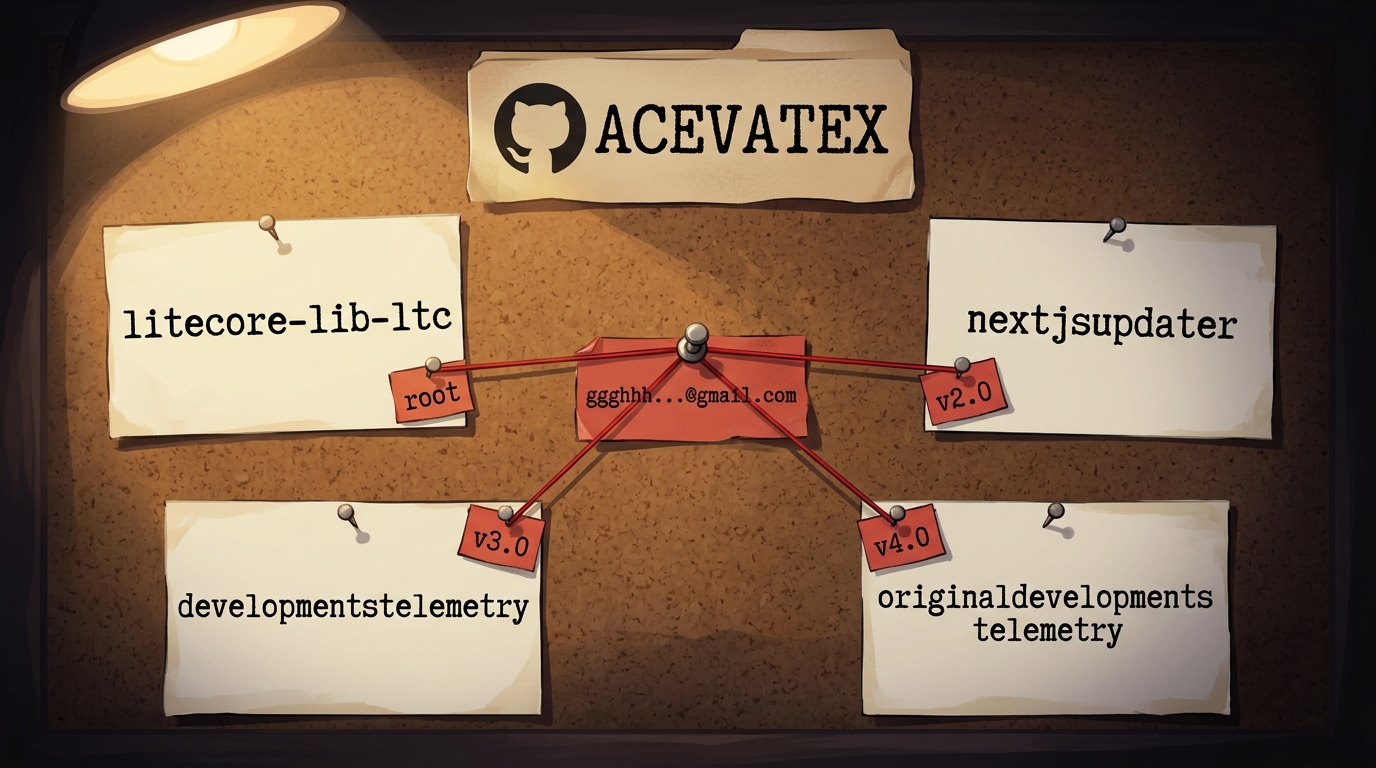
We were updating our campaign dossier on a minor threat actor when what we thought was an unrelated threat record fell into place.
"Acevatex" is the threat actor behind a burst of three malicious npm packages from August 2026. They're named that way because it's their consistent handle across GitHub and numerous online platforms.
litecore-lib-ltcis a working Litecoin wallet library first published to npm on March 1, 2026. From version1.9.10it sends every new wallet's private key to a Discord webhook.
Nothing in litecore-lib-ltc's code points at the Acevatex identity. So how did we make the connection?
The npm account's email is our smoking gun, but it's not as simple as an identical email across all the accounts. Instead, the operator used a shared Gmail root, adding a version number rag with each subsequent account. That one field turned a one-off stealer and a burst of unrelated loaders into a single operator, and showed they'd been publishing malicious npm packages since at least March 2026.
To be clear, this isn't a significant campaign or threat actor. What makes it worth a closer look is how we connected the dots because the operator reused the same things across multiple attacks:
Shared email root: four npm accounts (a.k.a "code puppets") all used the
ggghhh1122334455667788@gmail.comemail address root.One handle, even in the malware: Two packages hardcode
Acevatexas the GitHub owner they download from. The operator used the same handle for their GitHub account, and it shows up on several other platforms with the same avatar.Debugging in public: In every burst, the operator pushed code live and fixed it in place.
The post walks through the connections between packages, what the operator built, and what we do (and don't) know about this threat actor.
The threat actor's GitHub and two of their malicious npm packages
litecore-lib-ltcanddevelopmentstelemetrywere still live as of the publishing of this blog. This is in spite of there being OSV records for all of their malicious packages, and obvious ties to the github.com/acevatex organization. We have reported this gap to GitHub and npm.
Key facts
Click here to see all the associated threat records.
Threat actor
Acevatex, a.k.a. "Ace"
Threat type
Cryptocurrency credential theft
Activity
March 2025 to August 2026
Ecosystems
npm, GitHub
Malicious packages
litecore-lib-ltc, nextjsupdater, originaldevelopmentstelemetry, developmentstelemetry
What links the packages
Three loader packages share code, the GitHub URL and timing. litecore-lib-ltc shares the email root and publishing habits.
Connecting malicious activity through accounts
npm records an email address for every maintainer. The four most recently published packages came from four different accounts. Each has a different email address but they're all built on one root, ggghhh1122334455667788@gmail.com. The oldest account uses it as-is while other three add v2.0, v3.0 or v4.0.
Note: We'd love to know if this root has been used on other packages but npm doesn't support an email lookup.
Package
npm account
Maintainer email
First published (UTC)
What it does
OSV advisory
litecore-lib-ltc
johnstone
ggghhh1122334455667788@gmail.com
2026-03-01
Working Litecoin wallet library that sends each wallet's private key to Discord
MAL-2026-18442
nextjsupdater
johnmm
ggghhh1122334455667788v2.0@gmail.com
2026-08-30 02:30:29
Exported function downloads an HTA from GitHub and runs it with mshta
MAL-2026-15631
originaldevelopmentstelemetry
originaldevelopments
ggghhh1122334455667788v4.0@gmail.com
2026-08-30 04:43:58
Same loader function and GitHub URL as nextjsupdater
MAL-2026-15586
developmentstelemetry
originaldevelopment
ggghhh1122334455667788v3.0@gmail.com
2026-08-30 04:53:57
postinstall wrapper that runs the originaldevelopmentstelemetry loader on install
MAL-2026-17318
The registry still shows the emails for litecore-lib-ltc and developmentstelemetry. Chi Tran documented the johnmm address. The v4.0 address comes from our own records, because npm has since replaced that package with a security placeholder. Strangely, the suffixes don't follow publish order. The v4.0 account published ten minutes before the v3.0 account, so the numbering most likely reflects the order the accounts were created.
The johnstone account does has a history that predates the publishing of litecore-lib-ltc. In 2023 it published ttwehave, a dependency-confusion bug bounty test whose description reads "Hacked by johnstone@wearehackerone.com". Their HackerOne profile shows that researcher is still active and based in China. In fact, that package was reported as malicious back in 2024. At some point between ttwehave and litecore-lib-ltc, the account's email changed to the Gmail root. npm doesn't support account history, so we don't know when the email changed or whether the account lapsed (according to the npm Docs, a deleted account's username becomes available for other people to claim after 30 days). Based on our research, we don't think the HackerOne researcher and Acevatex are the same person. The account most likely changed hands, either through a takeover or because the name was re-registered, rather than a researcher turning blackhat.
Before this, the picture was fragmented. Chi Tran analyzed nextjsupdater in depth, checked for related packages and found none. OSV holds four advisories that don't reference each other. We had originaldevelopmentstelemetry attributed to Acevatex and suspected developmentstelemetry but hadn't confirmed it. Although litecore-lib-ltc had been reported to OpenSSF and catalogued as malicious, no one placed it anywhere near this operator until now.
How strong each link is
The three August packages are tied together by more than the email.
nextjsupdaternames the GitHub account in its code: Itsindex.jshardcodes the ownerAcevatex, the repoTestprogram, the branchmainand the fileupdater.hta. That's as direct as a link between a package and a repo gets.The publisher and the repo owner moved in step: Version
1.2.1was published at 02:52:19 UTC and referencedupdater.hta. That file was uploaded to the repo at 02:55:15. The package pointed at a file three minutes before it existed, which is hard to explain unless one person controlled both.originaldevelopmentstelemetrypicked up wherenextjsupdaterleft off: All threenextjsupdaterversions were unpublished at 03:41:34. Sixty-two minutes later a new account publishedoriginaldevelopmentstelemetrywith the same exporteddownloadAndRunUpdate()function, the same GitHub URL and the same version number,1.2.2, thatnextjsupdaterended on.developmentstelemetrydeclares originaldevelopmentstelemetry as a dependency: Ten minutes after that, a third account published a 143-byte package that lists originaldevelopmentstelemetry in its package.json dependencies and whosepostinstallscript importsoriginaldevelopmentstelemetryand calls its loader. Installing it was enough. No one had to call a function.
litecore-lib-ltc has none of that. It shares no code, no infrastructure and no webhook with the loader chain. The email root is the only direct link, and the publishing habits described below are the only indirect one. We think that's enough, because the root is twenty-two characters of someone mashing a keyboard and the version suffixes show one person registering accounts in sequence. But if you're weighing this finding, know that the email is what carries it.
Debugging in public
In the 2026 activity bursts, the operator works the same way. They push code to the live npm registry or a public GitHub repo, see what breaks and fix it in place, often within minutes. That reads as an inexperienced operator.
litecore-lib-ltc, March 1, 2026
The registry history shows it being debugged in public. Thirteen versions went up in under two hours on March 1:
22:23 UTC: Version
1.0.0, a working library with no theft.22:39:48: The Discord webhook that would receive the keys was created.
23:18:43: Version
1.9.8added the theft, but forgot to import its HTTP client, so creating a wallet would throw before anything was sent.Version
1.9.9: Moved the call intowallet.js. Still no import.Version
1.9.10: Added the import. This is the first version that actually sends a key.00:17 on March 2: Version
1.9.14, the last one, cut the payload down to the private key alone.
A long version history also does work on its own. Thirteen releases make a package look maintained if you don't inspect the dates closely, and anyone who samples an early version finds a clean library. Whether that was the goal or a side effect, the history itself reads as debugging. Each version from 1.9.8 on fixes something the attacker got wrong, and none of them is safe to use.
nextjsupdater, August 30, 2026
The first loader package went through three versions in 45 minutes. Each changed a single line, and each change was about how to run the second stage.
Version
Published (UTC)
File it downloads
How it runs it
1.0.0
02:30:29
updater.bat
cmd.exe /c
1.2.1
02:52:19
updater.hta
cmd.exe /c
1.2.2
03:15:09
updater.hta
mshta directly
Other examples from July-August 2026
Pointing at files before they existed:
nextjsupdater1.2.1referencedupdater.htathree minutes before the file was uploaded to GitHub. Later that morning,developmentstelemetry1.0.2depended onoriginaldevelopmentstelemetry1.2.7two minutes before that version was published.Re-releasing the telemetry packages: About five hours after the first versions, both telemetry packages got new versions, published three minutes apart.
Swapping binaries on GitHub: The operator deleted and reuploaded the test executable
RunTest.exein theTestprogramrepo twice, once 13 seconds after deleting it and once 50 seconds after. On July 4 they had done the same withprint.exe.
The Exodus patcher, August 4 to 6
The Asar repo took seven commits over three days, including two README edits, one titled "Replace passphrase emit with global sendPassphrase" and another two days later titled "Update replaces". The function the patch finally calls is named sendPassword, not sendPassphrase.
What the operator built
The cluster holds four distinct tools, built in bursts between March 2025 and August 2026. Each shipped with bugs, but also each is a little more capable than the previous one. The cookie stealer, the Litecoin key stealer, and the Exodus patcher are the operator's own code, and all three send stolen data to Discord. The fourth tool (the npm loader chain) ends in PureRAT, which is a malware-as-a-service RAT the operator didn't write and it sends data to its own C2 server. They're separate pieces. Nothing we've found shows one delivering another, apart from the npm loaders delivering PureRAT.
March 17 2025: a cookie-stealing SVG in GitHub
The earliest artifact is image.svg in the Acevatex/SVG repo, created on March 17, 2025. It embeds JavaScript that reads document.cookie and posts the value to a Discord webhook with the label Stolen Cookies:. Whether it steals anything depends on where the SVG is rendered and what the browser allows, but the intent is plain. It reads like a proof of concept. Two weeks later, Acevatex/DaPy appeared with broken Python test code and nothing malicious.
March 1, 2026: a Litecoin key stealer in npm
litecore-lib-ltc is a working Litecoin wallet library. Its calls to BlockCypher, Binance, CoinGecko and CoinCap are normal library functions. The malicious part is small: when a wallet is created, the library sends its private key in WIF format to a Discord webhook. It doesn't sweep funds or contain an attacker wallet address. Whoever holds the webhook gets the key and can move the funds whenever they like.
August 4, 2026: an Exodus wallet passphrase patcher in GitHub
The Acevatex/Asar repo, created on August 4, 2026, holds a modified copy of the Exodus desktop wallet's app.asar (about 79.7 MB), a patch tool called TestSwapper.exe and its C++ source. The README tells the operator to drop the modified archive into %LOCALAPPDATA%\exodus\app-26.7.30\resources\.
The patch changes one line in Exodus. Where the app normally runs this.emit("passphrase:set", e), the patched version first calls globalThis.sendPassword(e), which sends the plaintext passphrase to a Discord webhook along with a SHA-256 fingerprint of the machine. Then the original event continues, so the wallet keeps working and the victim sees nothing wrong.
Replacing app.asar needs access to the victim's machine. Nothing we've found shows how the operator planned to get it there. The npm chain doesn't deliver it.
August 30, 2026: an npm loader that ends in PureRAT
The three August packages all lead to the same place.
Chi Tran's analysis walks through all nine layers in detail, so here's the short version:
The npm package: Downloads
updater.htafromAcevatex/Testprogramand runs it withmshta. The repo now serves the same file asupdate.hta.The HTA: Hides its window, creates
%TEMP%\WinSATand uses Windows' owncurl.exeto fetch the next stage. It starts that stage through WMI, so the new process isn't a child ofmshtaand process-lineage detections don't fire.The payload server:
79.110.49.129:8080/ayan/serves three files under random names. The HTA saves them aspurelast.exe,o.exeandov.dat.A PyInstaller bundle:
purelast.exeis a 6.6 MB Python bundle whose only job is to carry a batch script.An obfuscated batch script: 588 KB, with its real commands hidden behind 1,778 variables and Greek homoglyphs. It copies itself to
C:\ProgramData\IntelDriver\LwWN.cmdand copiespowershell.exeto a hiddenHslPrompt.exe, which it uses for everything that follows.Payloads hidden in comment lines: The script reads two base64 payloads out of its own comment lines.
An AES-encrypted PowerShell injector: Decrypts the next stage and injects it into
explorer.exe.Donut shellcode: Patches AMSI, ETW and WLDP, then starts the .NET runtime.
A .NET loader: Decrypts PureRAT with TripleDES and loads it. PureRAT connects to
217.60.77.60on ports 56001 to 56003, using a pinned certificate with the subjectCN=PureRAT Agent.
Persistence is a hidden scheduled task named fMug, described as IntelDriver System Service, plus PureRAT's own task that relaunches every five minutes. The RAT's hardcoded target list is 48 browser extensions (including Authy and other authenticator apps), 35 browser profile paths, 10 desktop wallets, Telegram Desktop and Foxmail. It also captures the screen and logs window titles.
The hard part here was bought, not built. Chi Tran describes PureRAT as part of the Pure malware-as-a-service family, and notes the client carries de4dot naming, which suggests it was packed from someone else's deobfuscated build. Donut is a public shellcode generator. The payload host also serves unrelated German invoice-lure droppers and an ARM Linux binary, so it's shared criminal hosting rather than infrastructure this operator set up. What o.exe and ov.dat do is still unknown.
Timeline
The threat actor's confirmed activity comes in three bursts:
March - April 2025: Two GitHub repos created with evidence of malicious intent (one holds the cookie-stealing SVG, the other some Python test code that doesn't run) added within minutes of creation.
March 1-2 2026: One malicious npm package published 13 versions in under two hours (
litecore-lib-ltc, with the webhook for the stolen keys created partway through).June - August 2026: The operator created two more GitHub repos, Testprogram for staging payloads and Asar for the Exodus patcher. On August 30 they published all three loader packages within two and a half hours, then kept committing to Testprogram until 20:33 UTC, more than 15 hours later.
Inside each burst the work happens in hours. Between them, nothing for months. Discord webhook IDs are snowflakes that encode the moment they were created, so we decoded those and added them alongside GitHub and npm timestamps.
Date
Time (UTC)
Event
2022-08-20
04:30:23
GitHub account Acevatex created
2025-03-16
01:44:28
Discord webhook created for the SVG cookie stealer
2025-03-17
05:49:49
Acevatex/SVG created with image.svg
2025-04-01
06:25:19
Acevatex/DaPy created (broken test code, not malicious)
2026-03-01
22:23
litecore-lib-ltc 1.0.0 published by johnstone npm account
2026-03-01
22:39:48
Discord webhook created for litecore-lib-ltc
2026-03-01
23:18:43
litecore-lib-ltc 1.9.8, the first version with key theft
2026-03-02
00:17
litecore-lib-ltc 1.9.14, the last of 13 versions
2026-06-27
05:54:22
Acevatex/Testprogram created
2026-08-03
21:54:29
Discord webhook created for the Exodus patcher
2026-08-04
01:10:17
Acevatex/Asar created
2026-08-06
22:31:10
Last push to Acevatex/Asar
2026-08-19
04:50:56
Acevatex/frontend created (a mempool snapshot, not malicious)
2026-08-30
01:13:49
Discord webhook created for test.bat and RunTest.exe
2026-08-30
01:14:46 to 01:14:59
Files uploaded to Testprogram
2026-08-30
02:30:29
nextjsupdater 1.0.0 published
2026-08-30
02:52:19
nextjsupdater 1.2.1 published, referencing updater.hta
2026-08-30
02:55:15
updater.hta uploaded to Testprogram
2026-08-30
03:15:09
nextjsupdater 1.2.2 published
2026-08-30
03:41:34
All three nextjsupdater versions unpublished
2026-08-30
04:43:58
originaldevelopmentstelemetry 1.2.2 published
2026-08-30
04:53:57
developmentstelemetry 1.0.1 published
2026-08-30
09:58:56
developmentstelemetry 1.0.2 published, depending on originaldevelopmentstelemetry 1.2.7
2026-08-30
10:01:13
originaldevelopmentstelemetry 1.2.7 published
2026-08-30
16:33:11
npm replaces originaldevelopmentstelemetry with a security placeholder
2026-08-30
20:33:10
Last push to Testprogram
2026-08-31
18:03
OSV publishes MAL-2026-15631 for nextjsupdater
2026-09-23
Chi Tran publishes his analysis of nextjsupdater
What we know (and don't) about the operator
We can confirm the accounts behind this activity. Everything beyond them is a lead, and we've noted how much weight each one can bear.
What's confirmed
The GitHub account:
Acevatex, immutable user ID111625044, created August 20, 2022. The display name is "Ace" and the bio reads "Coder In Free Time." All 22 public commits resolve to the account's own noreply address, and GitHub's server-side events tie the uploads to it.The npm accounts:
johnstone,johnmm,originaldevelopmentsandoriginaldevelopment, tied together by the sharedggghhh1122334455667788email root.
Leads
A New Zealand timezone: GitHub commit records keep the original timezone offset. The account's March and April commits use UTC+13 and its June through August commits use UTC+12, which matches New Zealand daylight saving time. It points to a location but doesn't prove one.
Minecraft activity: A CurseForge author named
Acevatexpublished the Minecraft modpack "Create: Computing" on January 9, 2025. Then in December 2025, theAcevatexGitHub account opened an issue in a NeoForge Minecraft project.Activity under the same handle on different platforms: The threat actor consistently uses Acevatex or minor variations across SpigotMC (joined October 18, 2024), YouTube (joined June 10, 2020 with a New Zealand location), X (created May 2024 as
AcevatexRBLX, with RBLX being short for Roblox), and Reddit (2 years ago). They all use the same profile photo from GitHub. Via Reddit, we also connected them to a Discord account under the handlepromptexityand name "Ace". The shared profile photo is the strongest tie between these accounts and GitHub, but we haven't found an account-level link such as a shared email or a verified cross-link.A name in build paths: Two executables uploaded by the confirmed account contain the paths their compiler recorded.
RunTest.exewas built underC:\Users\Sam Lindores\source\repos\andTestSwapper.exeunderC:\Users\samli\source\repos\. Each was compiled within about two minutes of its upload, though compile timestamps can be set by whoever builds the file.
What we can't say
Whether the name is real: We assess with high confidence that the build machine used the identity Sam Lindores, and with medium confidence that the operator controlled that machine. A build path can come from an upstream developer, a compromised machine or a name planted on purpose. We don't treat it as a verified identity.
How the Exodus patcher would reach a victim: Replacing
app.asarneeds access to the machine. Nothing we've found shows how the operator planned to get it there.Whether anyone was hit: We have no victim data. Downloads of the
litecore-lib-ltcpackage are spread almost evenly across all 13 versions, which points to mirrors and scanners rather than developers.Whether the operator works alone: The payload host also serves unrelated malware, and VirusTotal associates the C2 with other PureRAT clients. That fits rented infrastructure, but we can't rule out a closer relationship.
Whether the npm account changed hands: The
johnstoneaccount used a HackerOne alias in 2023 and the Gmail root by March 2026, and we know of nothing it published in between. We don't believe they are the same individual, but this is not definitively confirmed by npm.
The threat is small but exists
nextjsupdater has been completely removed from npm and originaldevelopmentstelemetry remains with a security placeholder. But in spite of OSV issuing MAL records for all four packages, both litecore-lib-ltc and developmentstelemetry are still available for download. litecore-lib-ltc was still the latest version on npm on November 13, 2026.
litecore-lib-ltc still gets steady downloads, but they say little about victims. In the seven days before we checked, each of its 13 versions was downloaded between 111 and 128 times. Developers installing a package get the latest version, so an even spread across old versions looks like registry mirrors and security scanners pulling everything. deps.dev shows no dependents for any of its versions, and GitHub code search finds no project that uses it, so none of these downloads come from other packages pulling it in. Only 1.9.14, the latest, stood out, at 288. The weekly total also jumped to 2,341 for November 2 to 8, the week after OSV published its advisory, which fits security tools fetching a newly flagged package.
In addition, the Acevatex GitHub user account and all of its malicious repos are still up.
The payload servers were last confirmed live in September. Chi Tran found 79.110.49.129:8080 serving the first-stage payload and all three PureRAT ports on 217.60.77.60 open when he published on September 23. We haven't rechecked either.
If you installed one of these packages
litecore-lib-ltc1.9.10or later: Treat the private key of every wallet the library created as stolen. Move the funds to a new wallet generated on a clean machine.nextjsupdater,originaldevelopmentstelemetryordevelopmentstelemetryon Windows: If the loader ran, treat the machine as fully compromised. Rotate every password saved in the browser, re-enroll every authenticator app, move funds out of any wallet on the machine and log out all Telegram Desktop sessions. Check for a scheduled task namedfMug, a hiddenC:\ProgramData\IntelDriver\folder and a hidden%USERPROFILE%\Downloads\HslPrompt.exe.Exodus desktop wallet: Compare
resources\app.asaragainst a clean copy from Exodus. If it's been modified and you've entered your passphrase since, assume the passphrase is compromised. Move your funds using a new seed generated on a clean device. Changing the app password alone isn't enough.
On the network side, look for connections to 79.110.49.129 on port 8080 and to 217.60.77.60 on ports 56001 to 56003.
Indicators of compromise
npm packages
Package
npm account
Advisories
litecore-lib-ltc
johnstone
MAL-2026-18442, GHSA-9jxw-2pvm-5q9f
nextjsupdater
johnmm
MAL-2026-15631
originaldevelopmentstelemetry
originaldevelopments
MAL-2026-15586
developmentstelemetry
originaldevelopment
MAL-2026-17318
Accounts and email addresses
Platform
Indicator
Status
GitHub
Acevatex, name "Ace", user ID 111625044
Confirmed
GitHub
111625044+Acevatex@users.noreply.github.com
Confirmed
npm
johnstone, johnmm, originaldevelopments, originaldevelopment
Confirmed
ggghhh1122334455667788@gmail.com
Confirmed
ggghhh1122334455667788v2.0@gmail.com
Confirmed
ggghhh1122334455667788v3.0@gmail.com
Confirmed
ggghhh1122334455667788v4.0@gmail.com
Confirmed
CurseForge
Acevatex
Lead
SpigotMC
Acevatex
Lead
YouTube
@Acevatex
Lead
X
AcevatexRBLX
Lead
Acevatex
Lead
Discord
promptexity (name "Ace")
Lead
GitHub repositories
Repository
Contents
github.com/Acevatex/Testprogram
HTA loader, test executables, Discord webhook test
github.com/Acevatex/Asar
Exodus passphrase patcher
github.com/Acevatex/SVG
SVG cookie stealer
github.com/Acevatex/DaPy
Broken test code, not malicious
github.com/Acevatex/frontend
mempool snapshot, not malicious
Network
Indicator
Role
hxxps://raw[.]githubusercontent[.]com/Acevatex/Testprogram/main/updater[.]hta
Loader URL hardcoded in the npm packages
hxxps://raw[.]githubusercontent[.]com/Acevatex/Testprogram/main/update[.]hta
Same loader under its current name
79.110.49.129:8080
First-stage payload server
hxxp://79.110.49[.]129:8080/ayan/RuLnbcv9dlmEX7F6ez10[.]exe
Saved as purelast.exe
hxxp://79.110.49[.]129:8080/ayan/p5wPgZnWF3LGjsEbYryf[.]exe
Saved as o.exe
hxxp://79.110.49[.]129:8080/ayan/QFOltCgLKA0nGRcz6YmJ[.]dat
Saved as ov.dat
217.60.77.60:56001, :56002, :56003
PureRAT command and control
CN=PureRAT Agent, SHA-256 fingerprint E4:75:1A:1C:B3:CE:D4:14:0C:88:86:8A:6D:DB:34:D9:74:A6:82:F4:4D:60:A7:65:87:DB:85:9C:1D:A7:2A:4D
PureRAT pinned certificate
Discord
Webhook ID
Created (UTC)
Used by
1350645867757174795
2025-03-16 01:44:28
SVG cookie stealer
1477797533999956131
2026-03-01 22:39:48
litecore-lib-ltc
1533956249438257314
2026-08-03 21:54:29
Exodus patcher
1543428498956361788
2026-08-30 01:13:49
test.bat and RunTest.exe
The test.bat webhook is named "Spidey Bot" and posts to guild 1540518521119838311, channel 1540518522587979809. We've left out the webhook tokens because they work as credentials.
File hashes (SHA-256)
File
SHA-256
Description
update.hta
71b6879c6b18901c9282fa56a84cc5efd6fe8ace17878e6caf6a6f99c254ff21
HTA loader
purelast.exe
a64819733a85f798b5ebbfabcd94da6fa04c7e669f9a41a67aeaaa7e63337cfb
PyInstaller first stage
PowerShell injector
d7fe3fe6cd6d89b0575d95fa223669ce2551b1750b7bd81851d5ea52601116e2
Decrypted injector stage
Donut shellcode
2f1b131b90f2231bd90caf0c8241e82fe968ff1f651a4061376bc960bc882d0e
Decoded from HHLzY.png
Loader.exe
c5b9257e62d7844f09744bf37fd6f705d0e4069da6cc840652061f16bd2cbfb3
.NET loader
inner.dll
84815f65986c2a9e4d8db836dcde6c328f14f31cd219834e231ce0f04f5fa9d6
PureRAT client
RunTest.exe
bfeab9ae83f4636485a4d3ae4d413f04199d281f767a4d84fff1141cfea590e0
Discord test executable
print.exe
4792dc11f5fceb880af5a3b21c0e495384ed4d80fa86305a93bb9bc7f6adff1d
Windows executable, behavior unresolved
test.bat
2634221eb23ca1d9248a18c8f05753b0e2f59a063adca14fddc20aa9edbd3840
Discord webhook test
TestSwapper.exe
7cf480b860e23e003bbcb544805e8e1d39846ba05f26174b21747a5481b59ee5
Exodus patch tool
replaces
bfbd808732407090d6cf58a7c5462cb154a0978675c0f0744cc9a536724bc353
Exodus patcher source
image.svg
2e14391fb40b601c91a73c823c574d1c286bf4dc359184c33d42384eb3b40bcd
SVG cookie stealer
Host artifacts
%TEMP%\updater.htaor%TEMP%\update.hta%TEMP%\WinSAT\purelast.exe%TEMP%\DXCache\o.exeand%TEMP%\DXCache\ov.datC:\ProgramData\IntelDriver\(hidden, system attributes) containingLwWN.cmd%USERPROFILE%\Downloads\HslPrompt.exe(hidden copy ofpowershell.exe)Scheduled task
fMug, described asIntelDriver System Service, defined in%APPDATA%\fMug.xmland runningwscript.exeagainst%LOCALAPPDATA%\fMug.vbsA scheduled task that relaunches every five minutes at
RunLevel HighestThe bytes
DE AD BE CA FE BA EFat the start of aPAGE_EXECUTE_READWRITEregion inexplorer.exeA modified
%LOCALAPPDATA%\exodus\app-26.7.30\resources\app.asarcontainingglobalThis.sendPassword(e)Build paths
C:\Users\Sam Lindores\source\repos\RunTest.exe\andC:\Users\samli\source\repos\TestSwapper\