BLOG
WeaselBiscuit Strips BeaverTail and OtterCookie Down to Essentials
WeaselBiscuit is a lean new infostealer hiding in npm that we suspect was created by DPRK
By c0a15726-c5b1-4b0d-85e6-fe15553df9e2 ·
The OpenSourceMalware team spends a lot of time looking at malicious npm packages, and after a while you start seeing the same patterns over and over. So when something new and genuinely different shows up, it’s worth stopping for. That happened this week when we found 11 npm packages secretly hiding a brand new JavaScript stealer. It looks and feels like the DPRK’s BeaverTail and OtterCookie, but it isn’t quite either one. It’s smaller, lighter, and stripped down, with many of the heavier functions removed entirely.
We're calling it WeaselBiscuit. It isn’t an established family name. I made it up, and I think it’s dope.
Our automation flagged these packages as malicious and grouped them together because they share IOCs. That’s when we recognized an emerging Node.js infostealer architecture worth investigating, one that reads as a possible new or lightly documented DPRK-linked strain, or as a simplified branch or fork of the BeaverTail/OtterCookie ecosystem. You can see all the threat reports under the #weaselbiscuit tag.
Package
First seen
@biz44/id10-client
2026-09-12T13:51:46Z
@biz44/id12-client
2026-09-12T13:51:47Z
@biz44/id44-client
2026-09-12T08:03:37Z
@biz44/id79-client
2026-09-12T13:51:48Z
@biz44/id95-client
2026-09-12T13:51:46Z
@biz44/id99-client
2026-09-12T13:51:46Z
@biz44/process-runtime-utils
2026-09-14T04:41:47Z
@biz44/runtime-utils
2026-09-14T03:39:58Z
engin1
2026-09-16T03:44:28Z (version 1.3.99 still live on npm)
id79-client
2026-09-12T13:35:09Z
process-lhpm
2026-09-15T00:44:34Z
process-tailwind
2026-09-15T00:20:01Z
We're tentatively attributing this malware to DPRK but it's important to be clear that it's an analytic hypothesis, not a confirmed attribution. The recovered code has meaningful overlap with DPRK-associated Contagious Interview tooling, but we haven’t recovered operator infrastructure, victimology, campaign metadata, signing material, or a unique-code comparison sufficient to name a new family or conclusively attribute it to DPRK.
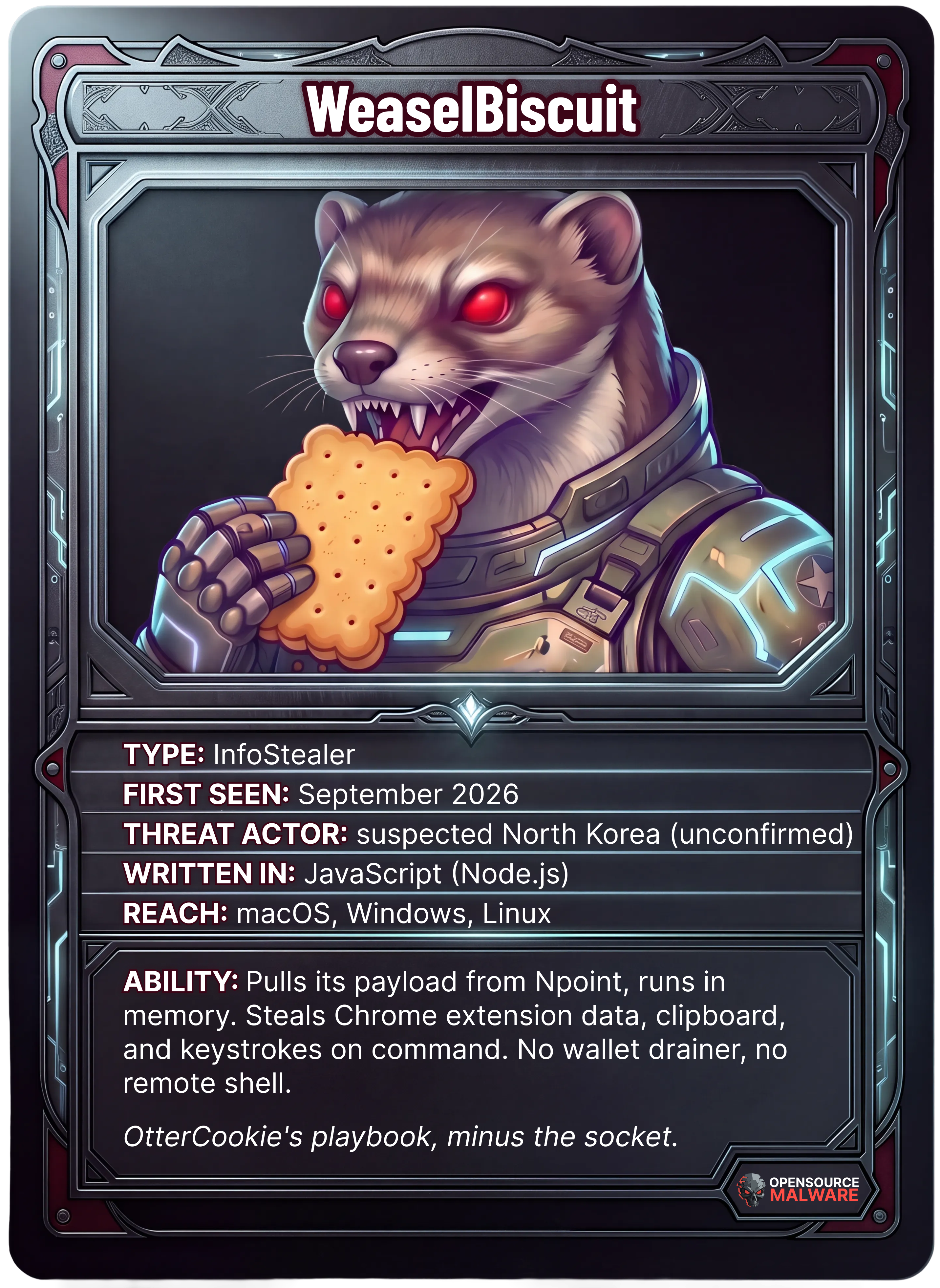 What WeaselBiscuit does
Lands via an npm
importand auto-runs a detached background Node processPulls its real payload from an Npoint URL and runs it in memory, never touching disk
Beacons to a shared HTTP C2 at
103.170.217.184:8787Profiles the host: hostname, user, OS, CPU/RAM, local and public IP, geolocation
Steals Chrome extension storage on Windows, macOS, and Linux, which is exactly where wallet extensions keep their signing state
Captures clipboard contents, on operator command
Logs Windows keystrokes, on operator command
Tags each install with a numeric campaign ID (
10,12,44,79,95,99) for server-side sorting
More on exactly what gets uploaded, and what doesn’t, in the Capabilities section below.
What it doesn’t do, compared to BeaverTail and OtterCookie:
No wallet-draining code, no hardcoded wallet extension ID list
No Chrome password decryptor, no seed-phrase regex sweep
No InvisibleFerret Python second stage
No screenshot module
No Socket.IO, WebSocket, or remote shell, just plain polling HTTP
No persistence beyond the detached Node process and a
.pidfile
Why it’s notable
The implant combines a package-borne Node.js loader, Npoint dead-drop resolution, Chrome extension-storage theft, clipboard collection, Windows keylogging, and a small custom HTTP control plane. Operationally, it’s simpler than commonly documented OtterCookie deployments:
npm import
  -> detached Node loader
  -> Npoint-delivered JavaScript
  -> Npoint C2 configuration
  -> plain HTTP C2 polling and exfiltration
There’s no Socket.IO, no remote shell, no screenshot capability, no Python InvisibleFerret handoff, no browser-password decryptor, no hardcoded wallet list, and no server-delivered follow-on payload in the recovered client. That absence could reflect an early-stage build, a deliberately reduced operational module, or a distinct actor copying familiar tradecraft.
Confirmed infection chain
An application imports
process-tailwind@1.1.99.index.jsautomatically callsinitialize().init.jsstarts a detachednode loader.jsprocess and stores its PID in<package-directory>/.pid.loader.jsretrieves JSON from:https://api.npoint.io/24c25d5f5fcbb0992a4fThe loader Base64-decodes the JSON
codefield and executes it throughnew Function.The retrieved response is an exact match for the supplied second-stage artifact, SHA-256:
7b15605f23b131b3eeea57e031ae7cb32fc4b78c7bbb2025aa7a561ea5ae5159The second stage obtains the C2 configuration from:
https://api.npoint.io/37c0a0c68bf7a94ed731The configuration resolves the C2 to:
http://103.170.217.184:8787
Campaign structure and identifiers
WeaselBiscuit isn’t an isolated sample. Static analysis and user-authorized inert retrievals identified a cluster of cloned npm loaders that pull near-identical WeaselBiscuit stages from distinct Npoint URLs. The stages differ materially only in a numeric identifier field included in system-information and Chrome-extension uploads, which strongly suggests a server-side campaign, tenant, operator, or victim-group label.
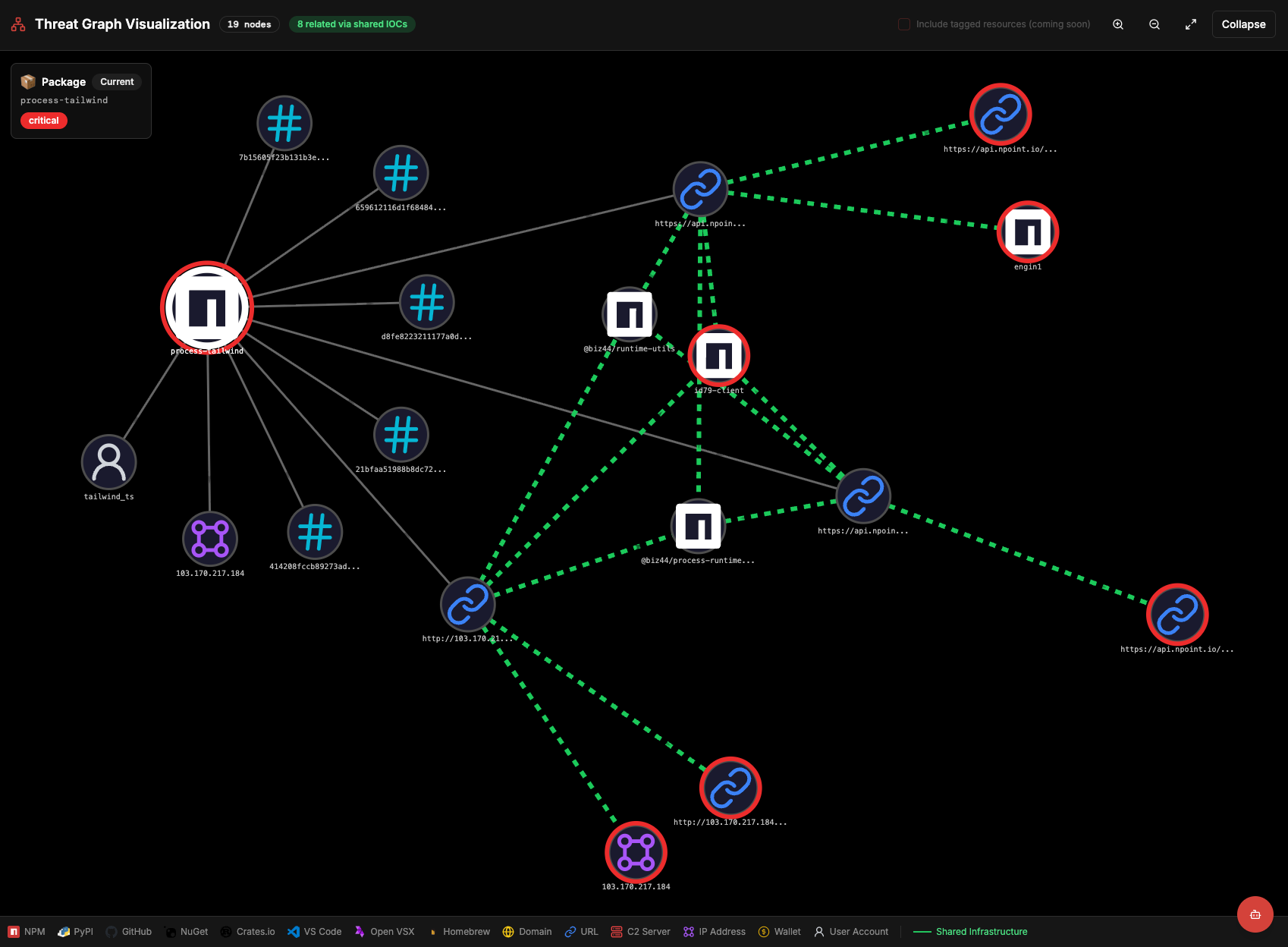
That clustering is easier to see than to describe. The graph below maps the shared infrastructure our platform recovered across the cluster, with process-tailwind at the center, connected through shared file hashes, Npoint resolver URLs, and the 03.170.217.184 C2 to id79-client, engin1, and the @biz44 packages covered in the tables below. It contains nineteen nodes, eight of them tied together by shared indicators rather than naming similarity alone. Every edge in this graph is a shared hash, resolver URL, or C2 address, not an assumption
First-stage resolver
Embedded stage identifier
Status
https://api.npoint.io/24c25d5f5fcbb0992a4f
99
Confirmed process-tailwind payload
https://api.npoint.io/641d37178a880b1e8b8f
10
Confirmed swnwall payload
https://api.npoint.io/33e8d008c334b060adad
79
Confirmed WeaselBiscuit clone
https://api.npoint.io/ddae72efbb6714fae922
12
Confirmed WeaselBiscuit clone
https://api.npoint.io/933a731a5e97f4b45249
95
Confirmed WeaselBiscuit clone
https://api.npoint.io/24c12c4b66a29747764f
Unknown
Hard-coded by id79-client; returned HTTP 404 when retrieved
All five recovered stages use the same second Npoint configuration resolver, https://api.npoint.io/37c0a0c68bf7a94ed731, which supplied the same C2: http://103.170.217.184:8787.
The confirmed stage-level identifiers are 10, 12, 79, 95, and 99. They’re useful as campaign-hunting markers, but their precise meaning isn’t yet known. The code doesn’t label them as campaign IDs.
Related npm packages
Package
Package label
First-stage resolver
process-tailwind@1.1.99
ID-99 Client Module
24c25d5f5fcbb0992a4f
engin1@1.3.99
ID-99 Client Module
24c25d5f5fcbb0992a4f
swnwall@1.2.10
ID-10 Client Module
641d37178a880b1e8b8f
id79-client@1.1.79
ID-79 Client Module
24c12c4b66a29747764f
All four package loaders share the same detached Node process, .pid marker, Npoint JSON retrieval, Base64 decoding, and dynamic new Function execution template. process-tailwind and engin1 have byte-identical loader, init, and index source files. The ID-79 label in id79-client is consistent with the separate recovered stage carrying identifier: "79", but the package’s current resolver response was unavailable, so that direct delivery link isn’t proven.
Capabilities
The WeaselBiscuit infostealer uploads the following to the IP-hosted C2:
Hostname, username, OS details, CPU, memory, home/temp paths, local interface IP/MAC addresses, public IP, and public-IP geolocation
Every readable, nonempty file under Chrome profiles’
Local Extension Settingsdirectories on Windows, macOS, and LinuxChanged clipboard contents, when the server enables monitoring
Windows keyboard events, when the server enables monitoring
The Chrome extension-storage capability is the financially relevant one. It can expose wallet-extension state or other extension-held sensitive data. Clipboard and keylogging can capture credentials, API tokens, wallet addresses, or recovery phrases entered or copied during normal use. That said, the code does not contain direct wallet draining, browser-password decryption, seed-phrase searching, or cryptocurrency transaction functionality.
C2 design
The C2 is a plain Express HTTP service, and its client-facing interface is small:
Route
Method
Function
/api/system-info
multipart POST
Host reconnaissance report
/api/upload-local-extension-settings
multipart POST
Chrome extension storage
/api/clipboard-status/<hostname>
GET
Clipboard collection switch
/api/clipboard-data
JSON POST
Clipboard exfiltration
/api/keyboard-mouse-status/<hostname>
GET
Keylogger switch
/api/keyboard-mouse-data
JSON POST
Keystroke exfiltration
The client polls the two status routes every five seconds. Recorded responses for a synthetic host were 200 OK Express JSON responses with isMonitoring: false. No payload, command, redirect, or next-stage URL was observed in those responses.
That’s a real departure from documented OtterCookie variants, which use Socket.IO and can support broader command execution. This is a polling infostealer control plane, not a full interactive RAT, at least in the recovered code.
How it compares to BeaverTail and OtterCookie
The overlap supporting the DPRK hypothesis is behavioral, not dispositive:
Node.js delivery and execution in a developer/package ecosystem
Browser extension-storage theft with potential wallet relevance
Native clipboard collection using
Get-ClipboardandpbpasteKeylogging, host profiling, and HTTP exfiltration
Use of lightweight external configuration to decouple the loader from C2 infrastructure
The divergences matter just as much:
No Socket.IO, WebSocket, or remote-shell client
No screenshots
No explicit crypto-wallet extension IDs, browser credential databases, or broad file-targeting rules
No InvisibleFerret/Python downloader
No observed persistence beyond a detached process and a local PID marker
Cisco Talos has reported that the line between BeaverTail and OtterCookie has blurred in recent campaigns, including Node.js keylogging, clipboard monitoring, extension and wallet data targeting, and shifting C2 architectures. That makes a lineage relationship plausible, but it doesn’t prove it. See BeaverTail and OtterCookie evolve with a new JavaScript module.
Capability comparison
Capability
BeaverTail
OtterCookie
WeaselBiscuit
Runtime
JavaScript (also ported to Qt/native)
Node.js
Node.js
Delivery
Fake-interview lure + malicious npm packages
Malicious npm packages
Malicious npm packages
Staging
Loaded directly by lure package
Loaded directly by lure package
Npoint dead-drop, Base64, in-memory new Function
C2 channel
HTTP POST to hardcoded C2
Socket.IO (bidirectional)
Polling HTTP (Express routes)
Host reconnaissance
Yes
Yes
Yes
Public IP + geolocation (nested ipify to ip-api)
Yes
Yes
Yes
Chrome extension storage theft
Yes
Yes
Yes
Hardcoded crypto-wallet extension ID list
Yes
Yes
No
Browser credential DB decryption
Yes
Partial (variant-dependent)
No
Seed-phrase / wallet-address regex sweep
Yes
Variant-dependent
No
File exfiltration (documents, keystores, profiles)
Yes
Yes
No (extension storage only)
Clipboard capture
Variant-dependent
Yes
Yes (operator-gated)
Keylogging
Not typical
Yes (recent variants)
Yes, Windows only (operator-gated)
Screenshot capture
No
Yes (recent variants)
No
Remote shell / arbitrary command execution
Via InvisibleFerret handoff
Yes (over Socket.IO)
No
InvisibleFerret / Python second stage
Yes
Yes (some variants)
No
Persistence
LaunchAgent / registry / startup entries
Detached process + variant-specific
Detached Node process + .pid marker only
Per-install campaign tagging in code
Not observed publicly
Not observed publicly
Yes, numeric identifier (10, 12, 44, 79, 95, 99)
Confidence and gaps
Claim
Confidence
Basis / limitation
Package is a malicious staged Node.js loader
High
Auto-start, detached loader, remote Base64 code execution, and exact recovered payload match
Second stage is an infostealer
High
Static collection and upload logic
103.170.217.184:8787 is the C2 used by this stage
High
Retrieved configuration and observed client routes
The implementation is a simplified or new branch
Moderate
Distinct architecture and reduced capability set, though it could also be a commodity copy
Linked to BeaverTail/OtterCookie lineage
Moderate
Npoint dead-drop pattern is near-identical to prior DPRK npm samples; nested api.ipify.org to ip-api.com lookup matches DPRK stealer convention; Express polling C2 reads as a lightweight port of OtterCookie’s Socket.IO control plane
DPRK attribution
Low to moderate
Consistent DPRK tradecraft signals, but no exclusive infrastructure or shared code recovered
A wholly new malware family
Low
Requires code-cluster, infrastructure, and victimology comparison
Three of those signals are worth walking through in more detail.
Tradecraft signals worth flagging
Npoint.io as the dead drop. DPRK npm crews have been using api.npoint.io as a first-stage dead-drop for a long time, and WeaselBiscuit’s usage is nearly identical to prior DPRK samples: hardcoded UUID, JSON blob containing a Base64 code field, in-process new Function execution. Same service, same shape, same execution pattern.
Nested public-IP and geolocation lookup. The second stage queries api.ipify.org for the public IP, then feeds that IP to ip-api.com for geolocation. That two-step nested lookup shows up in other DPRK-linked npm stealers too. It isn’t a common commodity design.
Express HTTP C2 as a lightweight port of OtterCookie’s Socket.IO plane. The C2 architecture itself is new: plain Express routes, polling-based, no bidirectional socket. But its shape, with per-host status endpoints gating live collection and separate exfiltration endpoints for clipboard and keyboard, reads as a stripped-down re-implementation of the same control model OtterCookie runs over Socket.IO.
Campaign markers resemble PolinRider. The numeric per-install identifiers (10, 12, 44, 79, 95, 99) baked into both package names and stage uploads mirror the campaign-marker convention seen in the PolinRider cluster. The operator is tracking installs at the same granularity, using the same “ID in the package name” pattern.
Indicators of compromise
Type
Value
C2
103.170.217.184:8787
Npoint resolver
https://api.npoint.io/24c25d5f5fcbb0992a4f (identifier 99)
Npoint resolver
https://api.npoint.io/641d37178a880b1e8b8f (identifier 10)
Npoint resolver
https://api.npoint.io/33e8d008c334b060adad (identifier 79)
Npoint resolver
https://api.npoint.io/ddae72efbb6714fae922 (identifier 12)
Npoint resolver
https://api.npoint.io/933a731a5e97f4b45249 (identifier 95)
Npoint resolver
https://api.npoint.io/24c12c4b66a29747764f (identifier unknown, hard-coded by id79-client, HTTP 404 on retrieval)
Npoint C2-config resolver
https://api.npoint.io/37c0a0c68bf7a94ed731
Second-stage SHA-256
7b15605f23b131b3eeea57e031ae7cb32fc4b78c7bbb2025aa7a561ea5ae5159
npm package
@biz44/id10-client
npm package
@biz44/id12-client
npm package
@biz44/id44-client
npm package
@biz44/id79-client
npm package
@biz44/id95-client
npm package
@biz44/id99-client
npm package
@biz44/process-runtime-utils
npm package
@biz44/runtime-utils
npm package
engin1 (v1.3.99)
npm package
id79-client
npm package
process-lhpm
npm package
process-tailwind (v1.1.99)
npm package
swnwall (v1.2.10)
Recommended investigation priorities
Preserve the npm tarball, package publication metadata, maintainer account, dependency graph, download history, and source repository references.
Search public and internal telemetry for all six Npoint UUIDs, the C2 IP and port, the stage identifiers
10,12,79,95, and99, and the API route strings.Compare the loader and decoded stage against known BeaverTail/OtterCookie samples for shared functions, comments, string conventions, package names, and C2 patterns.
Identify the importing parent application. The package itself has no npm lifecycle hook, so execution requires an import or a manual start.
Review affected endpoints for
.pidfiles, Node child processes, PowerShell processes, and%TEMP%\kb-monitor\keyboard-monitor-*.ps1.
Bottom line
Treat process-tailwind as a high-confidence malicious supply-chain package, and treat it as a potentially important data point in how DPRK-linked JavaScript infostealers are evolving. Treat the “new DPRK strain” label as a working investigative hypothesis, not a conclusion, until it’s backed by corroborating code, infrastructure, or campaign evidence.