BLOG
How a Fake Job Interview Led to the $6.34 Billion Binance Theft
North Korea's TraderTraitor used the Contagious Interview playbook. Any company holding crypto is a potential target.
By cb482791-4ef1-4762-96ad-b0ca4bdd538e ·
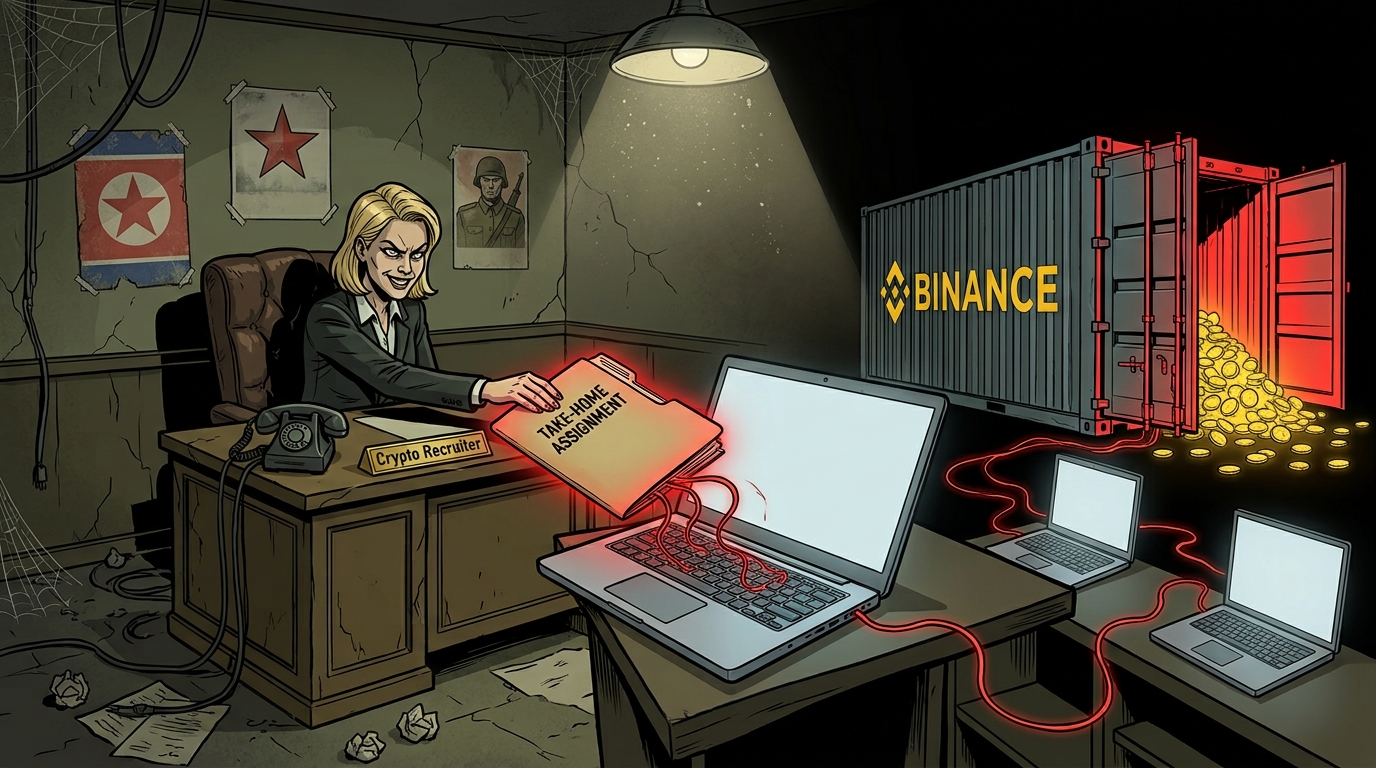
In September 2026, a software engineer at Binance got a message on a job-hunting site. Someone posing as a Project Director wanted to talk about a role. What followed looked like a normal hiring process. First came a live video interview with an HR representative, then a second round with someone claiming to be the CEO. Near the end of that call, the engineer was told to download a coding assignment. He did it on his work computer, and malicious code gave the attackers access to his machine and credentials.
The attackers moved laterally through the Binance organization, and on October 29 they stole about $6.34 billion in cryptocurrency. Binance's report lists the fake interview as one step in a longer chain. The developer wasn't the end goal. A candidate who runs an assignment on a work laptop hands the attackers a machine inside their employer's network.
The FBI attributes the attack to TraderTraitor, the same North Korean group it blamed for the $1.5 billion Bybit theft in February 2025. Blockchain analysts at TRM Labs and Chainalysis also linked the two thefts, saying the attack matched Bybit in a few ways:
The attackers started preparing at least 36 hours ahead.
The signatures were produced in advance as a batch, then used in one burst.
Three small Tornado Cash withdrawals funded the attackers' operator wallet.
None of these alone proves it's the same group. They're patterns TRM has seen in earlier North Korean heists, and TRM paired them with on-chain and off-chain intelligence it didn't detail. Chainalysis said its strongest evidence was watching Binance funds mix in real time with proceeds from the roughly $357 million theft from crypto exchange Bitget in late September. Elliptic had already tied that hack to TraderTraitor in a preliminary assessment, citing on-chain overlaps with the Bybit attack. That chain of overlaps, from Binance to Bitget to Bybit, is the clearest public link between the attacks.
The fake interview that compromised Binance follows the same playbook as Contagious Interview, a North Korean campaign that's been luring developers with fake job offers since at least 2023. That matters for defenders, but not as much as you might hope. Being able to detect Contagious Interview (or PolinRider, more on that below) activity is a good start. But it won't reliably catch TraderTraitor, which tailors its attacks to a small number of high-value targets. And no tool on the market today will stop a developer from consuming a malicious repository in the first place.
TraderTraitor vs. Contagious Interview vs. PolinRider
These names are easy to mix up, and they can overlap in practice. Contagious Interview is one of the main ways PolinRider gets onto a developer's machine, and TraderTraitor runs the same fake-interview playbook against higher-value targets.
Name
Category
What it is
TraderTraitor
Group
Also known as Slow Pisces, Jade Sleet and UNC4899, this group targets developers at large crypto organizations. It runs its own version of the Contagious Interview playbook, with coding challenges that are mostly Python or JavaScript and payloads that go only to vetted targets.
Contagious Interview
Campaign (tactic)
A playbook that's been run against everyone from freelancers to CTOs since at least 2023: a fake recruiter, a fake interview and a coding test that installs malware. Its operators are tracked as Famous Chollima, WaterPlum and UNC5342.
PolinRider
Campaign (tactic)
A self-propagating persistence campaign. Once one developer is infected, it spreads North Korean malware to others who never dealt with a North Korean operative directly. Infections can come from Contagious Interview, a poisoned OSS package, or a compromised GitHub collaborator.
How the Binance attack unfolded
Binance's report lays the attack out as a series of steps, but it reads more clearly as three phases. We think each phase was likely run by a different North Korean team, with each one handing off to the next.
Outside of this attack, Binance also says it detected and stopped 57 suspected North Korea-linked attacks in 2026, including fraudulent job interviews and malicious software disguised as popular developer tools.
Phase 1, a lucky break
In June 2026, a Wallet DevOps engineer searched for a popular AI coding tool and downloaded a tampered Homebrew installer from a lookalike site. This is a coarse-grained tactic, closer to email phishing than a targeted attack. Attackers put a malicious download out there with a little targeting and hope someone useful takes the bait.
It worked, but only briefly. Binance says it detected the anomaly, replaced the engineer's laptop and rotated his credentials. But this intrusion gave the attackers enough data to identify what the developer's role was and who he worked with on the wallet infrastructure team. That was enough to hand off to a more sophisticated hacking team.
Phase 2, a targeted way back in
Over the next two to three months, North Korea planned how to get back into Binance on purpose. In September 2026, they reached a second engineer through the fake interview described at the top of this post, and he ran the coding assignment on his work computer. Binance says the code ran during setup and replaced part of pyenv (an open source tool developers use to install and switch between versions of Python) with a malicious version that ran commands and connected to an attacker-controlled server. Binance said its endpoint security tools didn't detect this activity.
From that engineer's machine, the attackers used an internal AI tool to take control of at least two more machines. One belonged to the Phase 1 victim. The other belonged to a third developer who wasn't involved in either earlier step. There were probably more exposed individuals, but these are the two they chose to use.
This is a living-off-the-land attack: the attackers moved through Binance using Binance's own tools. That should raise questions about the internal AI tool. How was it manipulated into giving up access to other engineers' machines, and what permissions did it have that made that possible? Binance's report doesn't say.
Phase 3, the heist
The attackers had those machines by October 20, then waited nine more days before springing the trap. We don't know what they did with most of that time, but starting the morning of October 28 they funded the wallet they'd use for the theft and rehearsed the attack on other wallets. On the Phase 1 victim's new machine, they found a token with permission to deploy containers. On October 29, they logged into the third developer's computer, used that token to deploy a container, and ran a script against Binance's internal wallet signing service. About $6.34 billion left Binance hot wallets in under four hours.
Comparing a TraderTraitor interview to the Contagious Interview playbook
Let's take a look at the similarities between the TraderTraitor attack on Binance and the Contagious Interview playbook:
Step
Binance (September 2026)
Contagious Interview lures we've documented
First contact
A "Project Director" on a legitimate job-hunting platform contacts the target
Someone with a fake identity reaches out on a legitimate platform like LinkedIn, Upwork or Fiverr
Building trust
A live video interview with "HR," who shared a personal social media account with photos and videos
Fake profiles with hundreds of connections and full work histories, and live calls with the target
Escalation
A second round with someone claiming to be the CEO
A follow-up call with someone posing as a founder, CTO or technical lead
The ask
Download an "assignment" repo onto a work computer
Download a project and get it running as a coding test, often near the end of a call
Execution
Malicious code ran during setup
Malicious code hidden in the project's setup runs without the candidate's knowledge
Technical analysis of the Binance attack
Binance's report shares more technical detail than most incident write-ups, though it holds some back that would be useful to researchers and defenders. Here's what it confirms, what other research adds, and what's still unknown.
The malware hid inside pyenv
According to Binance, the code in the assignment repo ran during setup and replaced part of pyenv with a malicious version. Binance shared the file operations:
CREATE  /opt/homebrew/Cellar/pyenv/2.8.0/libexec/pyenv_
MODIFY  pyenv_ → 3,414 B
DELETE  .../libexec/pyenv  (3,344 B)   ← remove the valid pyenv
RENAME  pyenv_ → pyenv  (3,414 B)      ← replace it with a malicious version
DELETE  /opt/homebrew/bin/pyenv  (3,414 B)
ln  (create a new symlink)  +  spawn zsh
Binance says the malicious version ran commands and connected to an attacker-controlled server, used obfuscation to avoid detection, and that the attacker removed traces afterward.
Replacing an existing tool (e.g. pyenv) is a move we've seen in other North Korean malware killchains. For example, PolinRider victims have reported that the malware replaced the npm CLI (npm/lib/cli.js) with a malicious version that re-runs the malware each time they use npm. This means even if you cleaned everything else but missed the tool, the threat actor keeps persistence.
Similarly, pyenv also runs every time a developer uses Python through it, and on many machines every time a new shell opens. That may be why the script spawned zsh at the end. Either way, the attackers would get code that runs again and again from a file with exactly the right name and path. Where the Binance example diverges from the PolinRider samples is in file size. The malicious pyenv is only 70 bytes larger than the original, while the malicious npm CLI is about 1 MB instead of a few hundred bytes.
These killchains rarely rely on a single persistence mechanism. The stages we usually see look like this:
A staging script or loader, where the malware first runs
Overwriting a trusted developer tool (such as the npm CLI)
Command injection into apps the developer uses every day, like VS Code, Cursor, Discord, GitHub Desktop
Command and control
Exfiltration of credentials and secrets
A remote access trojan that keeps long-term access
Binance only described one of these, the tool swap. We'd speculate the rest of the chain looked similar, with other stages handling command and control, exfiltration and long-term access.
From one laptop to the wallet signing service
The attackers deployed the container and ran their script between 17:15 and 19:56 on October 29. Binance says the attacker used unauthorized access to an internal wallet signing service to start transactions outside the normal withdrawal process.
How the money left
The on-chain setup started more than a day before anyone touched the signing service. According to TRM, three small Tornado Cash withdrawals funded the attackers' operator wallet starting the morning of October 28. The operator then tested its attack code on two wallets, rehearsed the final version on a third and routed the test funds back to itself. Four hours after that rehearsal, the same code was installed on a Binance hot wallet.
Time (UTC)
What moved
Oct 29, 20:05 to 20:09
233.46 million XRP from five hot wallets
Oct 29, not specified
About 970,500 SOL and 44.2 million OP
Oct 29, not specified
18,270 BTC
Oct 29, 23:56
The final unauthorized transfer, 2,961.9 ETH
Oct 30, 00:10
Binance clears the malicious EIP-7702 delegation
The attackers also used the signing service to set up malicious EIP-7702 delegations on a hot wallet. According to TRM, this went out at 20:20 UTC as a single transaction carrying 50 authorizations, each signed in advance for a different nonce value. The attackers couldn't know what the wallet's nonce would be at the moment the transaction ran, so they signed one for each of the next 50. Whichever one matched took effect.
EIP-7702 is an Ethereum feature that lets an account hand some of its execution rights to a smart contract without giving up its private key.
A hot wallet is an internet-connected wallet an exchange uses for day-to-day withdrawals. Its nonce is a counter that keeps its transactions in order.
That gave an attacker-controlled smart contract partial execution rights over the wallet. Because those permissions lived on-chain, suspending withdrawals didn't stop them. And because the wallet used multi-party computation (MPC), which splits the signing key across several parties, there was no single private key to revoke them quickly. Binance says it has frozen or intercepted about $2.85 billion.
What other research adds
Binance doesn't describe the malware beyond the pyenv swap. Unit 42's research on TraderTraitor (which it tracks as Slow Pisces) describes coding challenges that are mostly Python or JavaScript. Payloads go only to targets that pass checks such as IP address and location, and later stages run mostly in memory. Unit 42 also describes a macOS stealer that goes after credentials, SSH keys and cloud configuration files. The interview malware at Binance also ran through a Python tool, and the /opt/homebrew paths in Binance's file listing point to a Mac, but we can't confirm it's the same tooling.
Most Contagious Interview lures in our data use Node.js and VS Code. But Python isn't new territory: our records include 64 Contagious Interview packages distributed through PyPI. Given this was a planned and targeted attack, we can reasonably assume North Korea had collected enough information about the team's tech stack to know this approach would work.
Why your tools might not detect this activity
Binance's endpoint security didn't catch the TraderTraitor malware, and that isn't a sign of carelessness. Every step of this attack looks like normal developer activity, and the tools most teams rely on for software threats are watching for something else.
EDR watches for unusual behavior
What it looks for
Why it fails
Unusual process execution, like a document opening a shell
A coding assignment running setup scripts, or a Python tool starting a process, is ordinary on a developer's machine
Suspicious files on disk, like a new executable in a temp folder
The pyenv swap changed one small script inside a legitimate Homebrew install. It kept its name and path and grew by 70 bytes
Connections to unusual destinations, like a newly registered domain
Developer laptops make outbound HTTPS calls all day, and the lures we track use common hosting and URL shorteners that blend in. Binance hasn't said where its malware connected. In our testing, about one in five supply chain network indicators were legitimate platforms like GitHub raw content, Telegram bot APIs and webhook services
Lateral movement, like remote logins from one workstation to others
The attackers moved through an internal AI tool, so it looked like a trusted tool doing its job
Unusual credential use, like a login from an unfamiliar location
The container deployment token was real, and the attackers used it from another employee's machine inside the network
Package security tools watch what you install
Most lures we track carry their malicious code in the repo itself, in setup scripts, editor tasks or config files, with ordinary dependencies. None of these tools are built to look there.
What it looks for
Why it fails
Private registries, like JFrog Artifactory or Sonatype Nexus, mirror and cache public packages so developers and builds install from one controlled source. Some add policy checks on what gets pulled in.
The interview assignment was a code repository handed to the engineer, not a package pulled through a registry. A mirror only sees what passes through it.
Package firewalls sit between a package manager and the registry and check each requested package version, including transitive dependencies, against malware verdicts. For example, npm install of a known-malicious package gets refused before anything downloads.
They only see packages requested through a package manager. Code that lives in the repo itself, Git dependencies and second-stage payloads fetched from attacker servers never go through them.
SCA and SBOM scanners read an application's manifests and lockfiles, or build an inventory of its components, and match them against known vulnerabilities and malware. For example, flagging a dependency that's known to be malicious on a pull request.
They only look at an application's dependencies. The interview code never entered Binance's codebase, and a tampered pyenv or npm CLI isn't in any application's dependency list
Reputation feeds only know what's already been flagged
It's reasonable to think general threat intel (e.g. VirusTotal, URLhaus and AbuseIPDB) fills this gap, but our data shows that supply chain attack IOCs mostly go undetected by these sources. That's because reputation services answer one question: has someone already seen this and called it malicious? Supply chain attacks rarely give them the chance. Malicious links are hidden in setup scripts and install hooks instead of being sent out in spam. Attacker servers wait for infected machines to call in instead of scanning the internet. That leaves nothing for a bad reputation to build on.
When we tested indicators from ten 2026 campaigns, 71.3% were still invisible to VirusTotal months after the attacks. That included 76.9% of the Contagious Interview indicators and 73.7% of the PolinRider ones. One Contagious Interview lure domain wasn't flagged by any of VirusTotal's 92 engines. The payloads didn't fare any better: most were scripts in install hooks and setup files, not compiled binaries, and 87.9% had either never been uploaded to VirusTotal or came back clean.
How to detect and contain these attacks
Assume someone in your org will eventually open or run one of these repos. No tool on the market today stops a developer from consuming a malicious repository, so the practical goals are to catch it fast and limit what one infected machine can reach.
All five steps below help against broad campaigns like Contagious Interview and PolinRider, which reuse infrastructure and techniques across many victims. The first two also hold up against targeted attacks like TraderTraitor, so start there.
Step 1: Limit what one compromised machine can reach
This is the most reliable control against all malicious open source, because it doesn't depend on recognizing the attack. At Binance, the interview gave the attackers one laptop, and everything after that depended on what that laptop could reach.
Internal AI tools: Know what they're allowed to do on other machines, and log and review what they do.
Deploy credentials: Keep tokens that can deploy containers off developer laptops, and make them short-lived and narrowly scoped.
Sensitive services: Systems that move money or sign transactions should only accept requests from places you expect.
Segmentation: A compromised developer machine shouldn't be able to reach other workstations or production systems.
Sandboxes: If you use VMs, Docker or dev containers to isolate untrusted code, check that credentials, shared folders and network access are actually kept out.
Short-lived environments: Doing development in short-lived cloud or container environments, instead of on a laptop with long-lived credentials, limits what a compromise can reach.
Branch protection: Block force-pushes and require signed commits on important branches, with no bypass for the accounts that push to them, so an infected machine can't quietly rewrite them.
Step 2: Hunt for tampered tools and auto-run tasks
Don't hunt for one filename or path. PolinRider's operators run several variants at once, testing which ones get past detections, and they change file names, locations, file types and obfuscation within days. Hunt for the patterns behind them instead. The same habit helps against targeted attacks, where you won't have a sample to search for at all.
Developer tools that changed: At Binance, the attackers replaced part of pyenv. PolinRider replaces npm/lib/cli.js. Compare these against a clean copy of the same version: npm pack npm@<your version> downloads the published npm package, and brew fetch --force pyenv downloads the official Homebrew bottle. For a quick first pass on a Mac, look for files under /opt/homebrew/Cellar that changed after the install time in that package's INSTALL_RECEIPT.json (timestamps can be faked, so a clean result doesn't prove much). File integrity monitoring on these folders will flag a change as it happens.
Editor tasks that run when a folder opens: Check every .vscode/tasks.json for tasks set to run on folder open, especially ones that run node against a file in an asset folder or pipe a script from a URL into a shell. Opening the repo in VS Code and trusting the folder is enough to run them. PolinRider's hidden task has run numerous variations of a fake font file, often in public/fonts/ folders nested inside legitimate-looking paths. These files hold obfuscated JavaScript, often pushed out of view by a long run of tabs or spaces. So instead of searching for names, run file on font folders and flag anything that reports as text. Also question any committed .vscode/settings.json that turns on task.allowAutomaticTasks, and parse tasks.json with a tool that tolerates trailing commas, since some samples break strict JSON parsers.
Config files with code where it doesn't belong: PolinRider appends one long line of obfuscated JavaScript after the legitimate contents of config files like eslint.config.mjs, often after a long run of whitespace so it sits off-screen in an editor, and has hidden loaders in prisma.config.ts. That line has ranged from about 5,000 to more than 37,000 characters, so look for anything after the expected export and for unusually long lines rather than a specific size. Because a config file runs whenever lint does, this route doesn't need VS Code at all.
Repos your developers push to: An infected machine rewrites commits in every repo its owner can access and force-pushes them to every branch within seconds. A burst of force-pushes across all branches from team accounts is the clearest sign. Infected machines also add .gitignore entries for config.bat, temp_auto_push.bat, temp_interactive_push.bat and branch_structure.json. GitHub code search only indexes the default branch, so scan every branch with a bare clone and git grep.
Step 3: Put campaign-specific threat intel where it can block or alert
Contagious Interview and PolinRider reuse infrastructure for a while, then rotate it, so expect indicators to become stale faster than with binary malware. Keep detections current by forward hunting on GitHub for the latest payloads, or use a feed like OpenSourceMalware's, which does that work for you and has more than 12,900 Contagious Interview records.
Domains, IPs and URLs: Block or alert on them at DNS, the proxy and your EDR. Many sit on platforms your developers use for real work, like Vercel, Render, GitHub raw content and webhook services, so target the exact subdomain or URL, not the whole platform.
Packages: Feed them to your private registry or package firewall so a flagged package is refused. Check that installs actually go through it. One lure we cataloged used an .npmrc file to pull a dependency from an attacker's server instead.
Blockchain wallets: North Korean malware often finds its command and control (C2) server by reading a blockchain, using techniques like EtherHiding and NullReceiver. Track the wallets these lookups use, and outside web3 teams, alert when a developer machine calls a public Ethereum RPC node like 1rpc.io or eth.drpc.org.
File hashes: Use them for hunting through old activity, not for blocking. Malicious open source files change constantly, so hashes stop matching fast.
Coverage: Make sure developer laptops and CI runners actually send data to these tools. Developer machines sometimes get EDR exclusions, so this is worth a check.
When new intel comes in, search your old DNS, proxy and EDR logs for it. These infections can run for months before anyone notices. In one PolinRider case we studied, infected machines kept force-pushing malware into the same repos for eight months.
Step 4: Make it easy to report a suspicious interview
Training developers to spot every lure won't get you far, because these interviews are built to look like real hiring. And plenty of developers assume they're too experienced to fall for one. A campaign that's been running since at least 2023 says otherwise.
What helps is giving people a reason and a way to speak up. Make sure they know a fake interview is usually aimed at the company, not just at them, then make it easy and blame-free to say "I ran something from an interview and I'm worried." A same-day report gives you a starting point for a hunt, and the recruiter profiles, repo links and domains they share can go straight into your detections.
Step 5: Make outbound connections ask first
An egress firewall (such as Little Snitch or LuLu) asks before any app connects somewhere new. In our view, that would stop most of this malware when it calls home to pull its next stage or send stolen data, as long as the developer reads the prompt and says no.
But there's a major tradeoff: the prompts are noisy.
When someone has to approve every connection and almost all of them are harmless, it's human nature to start clicking allow without reading. So while this may be one of the most effective ways to block malicious traffic, it only works as long as people keep reading. That makes it most worth the friction for engineers who can reach signing or deployment systems.