BLOG
Axios Attacker Behind Three More Malicious NPM Packages
Three malicious NPM packages connected to the March Axios compromise have been quietly harvesting developer credentials since early April
By c0a15726-c5b1-4b0d-85e6-fe15553df9e2 ·

The OpenSourceMalware team discovered a group of three malicious packages that deliver a powerful infostealer. They appear to be connected to the high-profile Axios package compromise that shook the JavaScript ecosystem in March 2026. While the security community focused on the immediate Axios incident response, the same threat actor was quietly deploying secondary infrastructure that has been harvesting developer credentials for nearly two months.
These packages represent a sophisticated follow-up campaign, using the same cryptographic keys as the original Axios attack but employing different command & control infrastructure to evade detection efforts focused on the known Axios IOCs.
The March 2026 Axios compromise
On March 31, 2026, attackers compromised the npm account of axios lead maintainer Jason Saayman via a social engineering campaign (fake company, branded Slack workspace, Teams call with a malicious "fix" prompt) and published two backdoored versions, 1.14.1 and 0.30.4, that injected a phantom dependency, plain-crypto-js@4.2.1, whose postinstall hook dropped a cross-platform RAT on Windows, macOS, and Linux from sfrclak[.]com:8000 before self-deleting and overwriting its own package.json. The attacker bypassed axios's OIDC publishing workflow with a stolen long-lived npm token and the malicious versions were live for about 3 hours before being removed, but with ~100M weekly downloads the blast radius was significant. Google Threat Intelligence Group attributed the campaign to UNC1069, a financially motivated North Korea-nexus actor, with Microsoft tracking the same activity as Sapphire Sleet
Many outlets called this event the biggest software supply chain attack of the year, and hundreds (thousands?) of organizations around the world have been affected.
To understand the significance of this new discovery, it's crucial to recall the timeline of the original Axios compromise:
Date
Axios Incident Events
March 30, 2026
plain-crypto-js@4.2.0 published to NPM as attack preparation
March 31, 00:21 UTC
axios@1.14.1 released with malicious dependency injection
March 31, ~01:00 UTC
axios@0.30.4 published; external detections begin
March 31, 01:38 UTC
Collaborator opened deprecation PR and contacted NPM
March 31, 03:15 UTC
Malicious Axios versions removed from NPM
March 31, 03:29 UTC
plain-crypto-js removed from NPM
The original Axios attack lasted approximately 3 hours and used social engineering to compromise the lead maintainer's computer, gaining access to NPM publishing credentials. The attack payload established C&C communication with sfrclak[.]com (142.11.206.73:8000).
The deployment timeline of these secondary packages reveals a calculated response to the Axios incident containment:
Date
Secondary Campaign Events
March 31, 2026
Axios malicious versions removed from NPM (03:15 UTC)
April 1, 2026
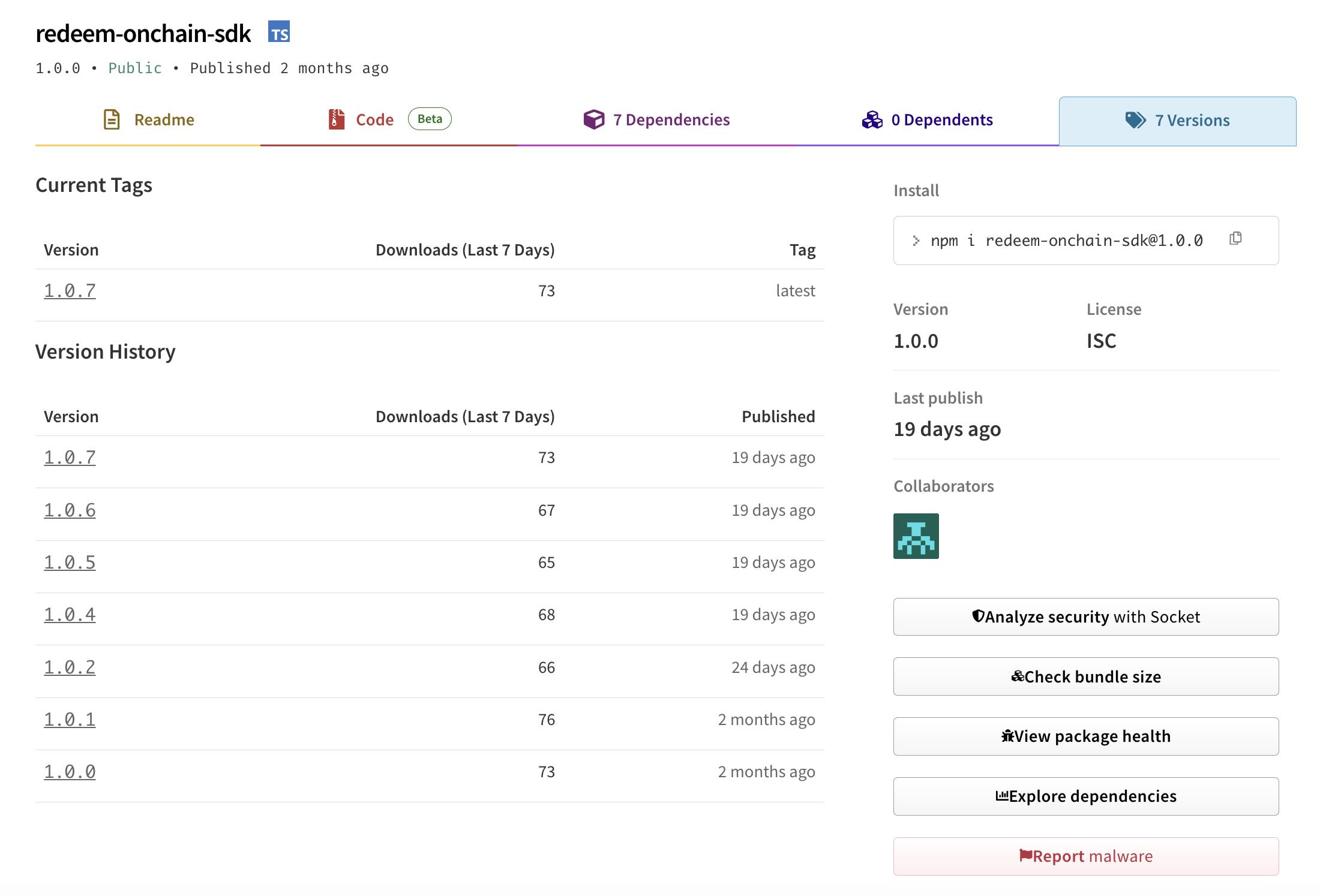
redeem-onchain-sdk@1.0.0 first published (~18 hours later)
April 2, 2026
First update to redeem-onchain-sdk
April 23, 2026
Major version update (1.0.2)
April 29, 2026
Rapid iteration with versions 1.0.4-1.0.7
April-May 2026
nicegui and period-newline packages published
The timing is remarkable: less than 18 hours after the Axios malicious packages were removed from NPM, the first secondary payload was already live on the registry. This suggests the threat actor had prepared backup infrastructure and was ready to immediately deploy alternative delivery mechanisms.
The attackers have been operating this secondary campaign for nearly two months, refining their approach while security attention remained focused on the known Axios IOCs.
Analysis of newly-discovered malware
The connection to the March 2026 Axios compromise becomes clear when examining the cryptographic artifacts of the latest packages. All three packages use the identical XOR decryption key `OrDeR_7077` that was first observed in the original Axios attack payload. However, while the Axios incident used C2 infrastructure at sfrclak[.]com (142.11.206.73:8000), these packages communicate with entirely different infrastructure at 18.208.244.120:9999.
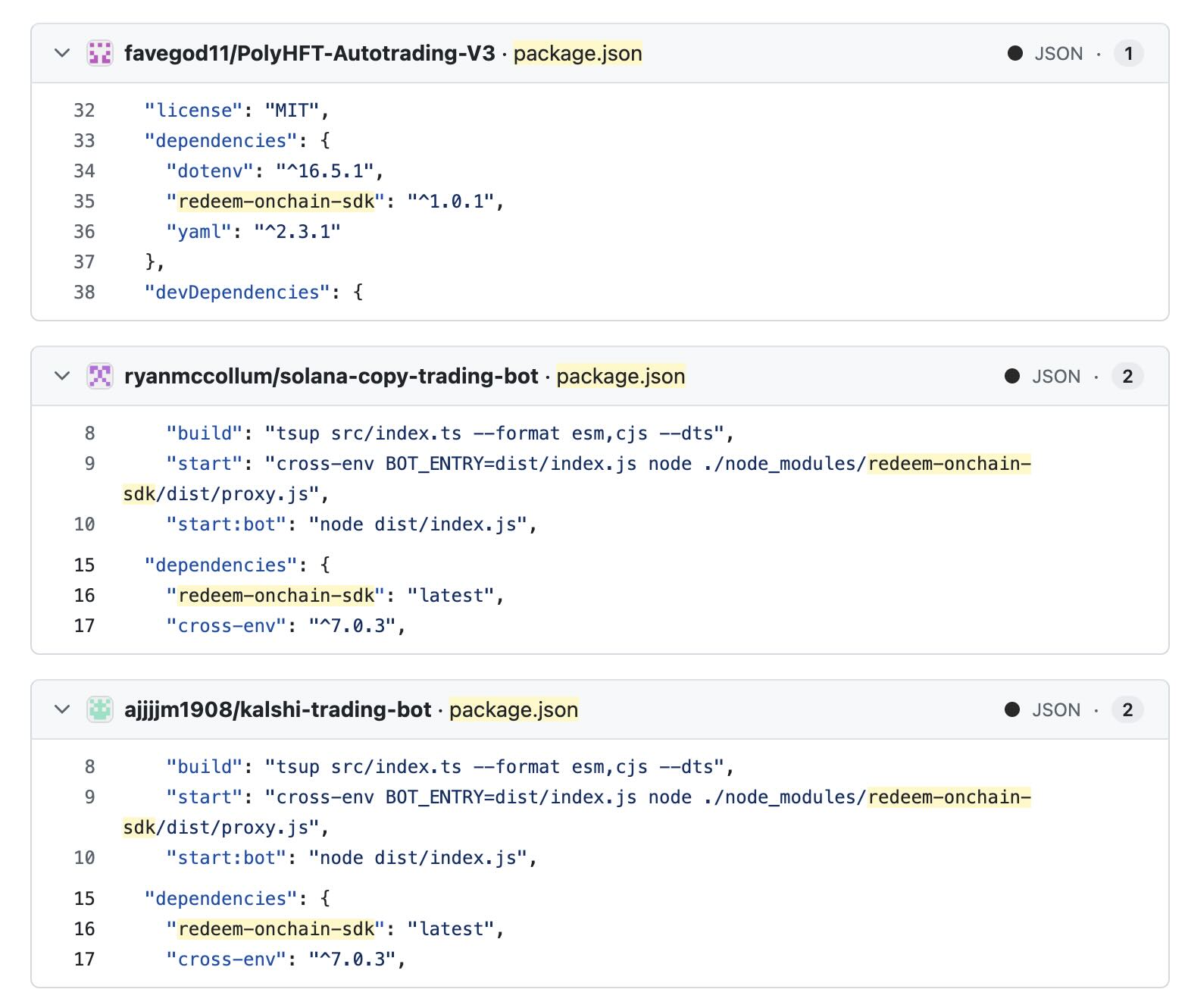
This suggests a deliberate strategy: deploy secondary infrastructure with the same malware capabilities but different IOCs to maintain persistence even after the primary campaign infrastructure was discovered and blocked. The easiest way to do this? Add this package to public GitHub repos and then invite Polymarket developers to work on them:
 The Secondary Payload Trio
The ryanmccollum1 NPM user has published a total of seven package downloads with 5,285 downloads in total:
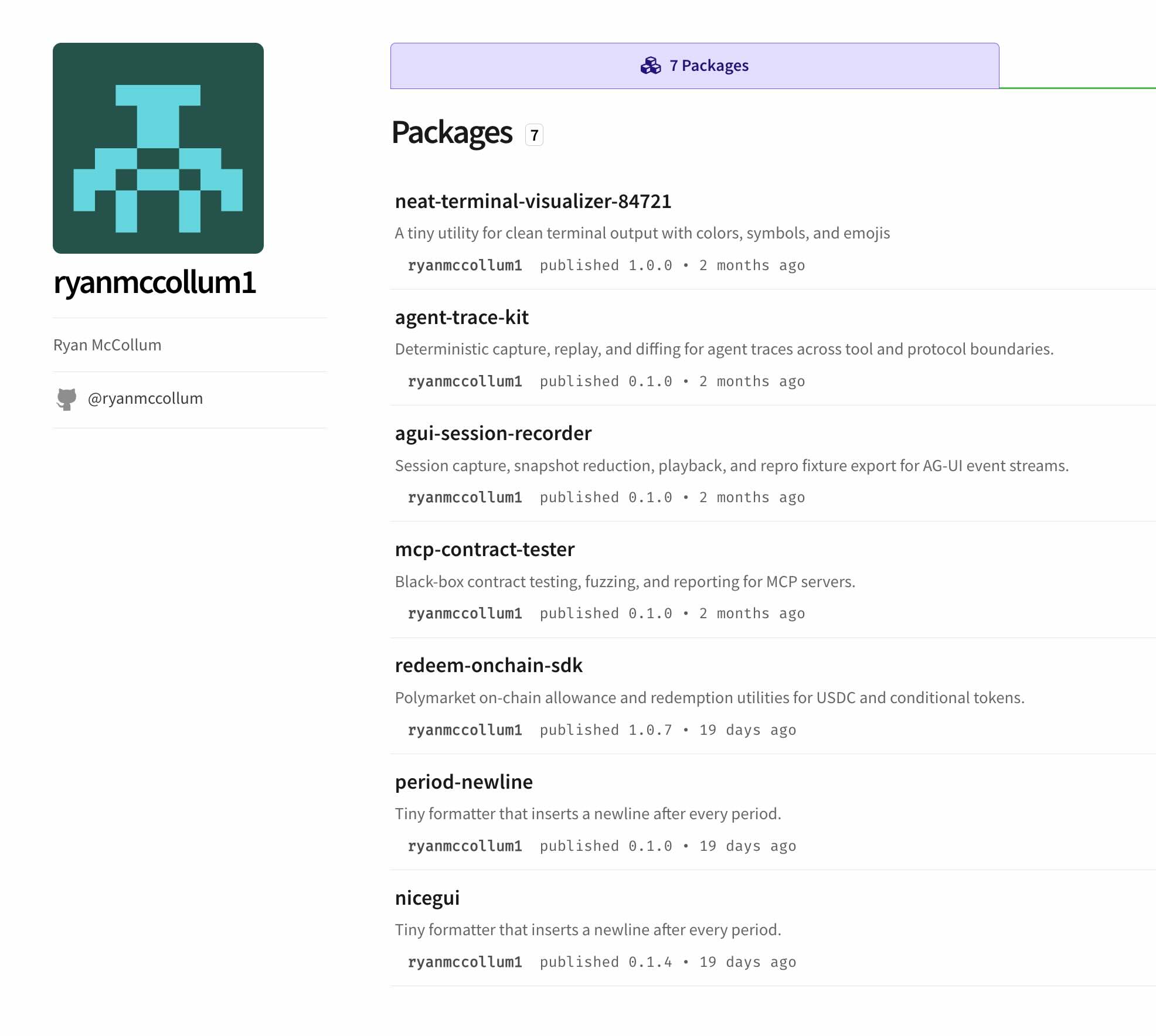 redeem-onchain-sdk: 2,746 downloads
nicegui: 1,609 downloads
period-newline: 387 downloads
agent-trace-kit: 140 downloads
mcp-contract-tester: 139 downloads
agui-session-recorder: 132 downloads
neat-terminal-visualizer-84721: 132 downloads
Of those seven, three of them employ strategically chosen payloads targeting Polymarket and two utilities:
redeem-onchain-sdk@1.0.7 - Masquerades as "Polymarket on-chain allowance and redemption utilities"
nicegui@0.1.4 - Disguised as a text formatting utility
period-newline@0.1.0 - Nearly identical to nicegui, also claiming to be a text formatter
All three packages share identical attack infrastructure and use the same malicious payload delivery mechanism through NPM's postinstall hook, but crucially, they avoid the IOCs that security teams were hunting for after the Axios incident.
1. Entrypoint Analysis
Execution Method: Auto-executes immediately when the file is required/imported
Self-Destruction: First deletes itself (
index5_test.js) and rewritespackage.jsonto hide evidenceObfuscation: Uses multi-layer encryption (AES-256-CTR + XOR + Base64) to hide malicious strings
Steganography: Uses innocent class names like
MarketDataHandlerto appear legitimate
2. Execution Flow
ENTRYPOINT: index5_test.js (auto-executing)
  ↓
CLEANUP: Delete self + overwrite package.json
  ↓
RECON: Collect system info (hostname, username, external IP)
  ↓
HARVEST: Steal sensitive config files
  ↓
ENCRYPT: AES-256-GCM encryption of stolen data
  ↓
EXFIL: TCP connection to C2 server
3. Network Communications
Primary C2 Server
IP Address:
18.208.244.120Port:
9999Protocol: Custom binary protocol over TCP
Encryption: AES-256-GCM with 32-byte static key
Secondary Connection
URL:
https://api.ipify.org?format=jsonPurpose: Discover external IP address of infected machine
Method: HTTPS GET request
4. Targeted Data
Credentials & Authentication Files
.envfiles (API keys, secrets, environment variables).home/.aws/credentials(AWS access keys).home/.ssh/id_rsa(SSH private keys).home/.ssh/config(SSH configurations).home/.npmrc(NPM registry credentials).home/.netrc(Network authentication credentials)
Platform-Specific Targets
Windows:
AppData/ssh/known_hostsLocalAppData/Google/Chrome/User Data/Default/Login Data(browser saved passwords)Docker:
.home/.docker/config.json(registry authentication)Temporary files:
/tmp/session_temp.json
Development Activity Intelligence
Git commit history from the last month (
git log --since="1 month ago" --format=oneline)
5. Technical Implementation
Obfuscation Scheme
Multi-layer string encryption: AES-256-CTR + custom XOR cipher + Base64 encoding
Dynamic string decoding: Proxy-based lazy decryption of obfuscated strings
Control flow obfuscation: State machine pattern to hide execution flow
Data Exfiltration Protocol
Encryption: AES-256-GCM with static key
00112233445566778899aabbccddeeff00112233445566778899aabbccddeeffFrame format: 4-byte length prefix + 12-byte IV + encrypted payload + 16-byte auth tag
Payload structure: JSON containing metrics and metadata
Transport: Raw TCP socket connection
Anti-Analysis Features
Self-deletion to remove evidence
Minimal error logging to
/tmp/.redeem_err.logTimeout protection on network operations (5-second limit)
Graceful failure handling to avoid detection
6. Visual Attack Flow
┌─────────────────┐    ┌─────────────────┐    ┌─────────────────┐
│   ENTRYPOINT    │ -> │    CLEANUP      │ -> │    RECON        │
│ index5_test.js  │    │ Delete self +   │    │ hostname, user  │
│ (auto-execute)  │    │ clean pkg.json  │    │ external IP     │
└─────────────────┘    └─────────────────┘    └─────────────────┘
          |                      |                      |
          v                      v                      v
┌─────────────────┐    ┌─────────────────┐    ┌─────────────────┐
│    HARVEST      │ -> │    ENCRYPT      │ -> │     EXFIL       │
│ .env, .ssh/,    │    │ AES-256-GCM     │    │ 18.208.244.120  │
│ .aws/, .npmrc   │    │ JSON payload    │    │ Port 9999 (TCP) │
│ git activity    │    │                 │    │                 │
└─────────────────┘    └─────────────────┘    └─────────────────┘
7. IOCs
Network Indicators
18.208.244.120:9999- Primary C2 serverapi.ipify.org- IP discovery serviceTCP connections to port 9999
File System Indicators
/tmp/.redeem_err.log- Error log fileindex5_test.js- Malicious payload (self-deletes)Modified
package.jsonwith minimal content:
Behavioral Indicators
Unauthorized access to credential files
Git command execution for reconnaissance
Outbound encrypted TCP traffic to non-standard ports
File deletion and package.json modification
8. Deobfuscation Results
The malware uses a sophisticated multi-layer obfuscation scheme identified by our deobfuscator as:
NiceGUI Multi-layer Obfuscation (98% confidence)
UNC1069 Multi-layer XOR Obfuscation (98% confidence)
Key obfuscated strings include:
C2 server IP:
MTguMjA4LjI0NC4xMjA=(base64: 18.208.244.120)Port:
OTk5OQ==(base64: 9999)File paths encoded with base64
Encryption keys split and concatenated
Indicators of Compromise (IOCs)
Original Axios Campaign (March 2026)
npm/axios@1.14.1
npm/axios@0.30.4
npm/plain-crypto-js@4.2.0
sfrclak[.]com (C2 domain)
142.11.206.73:8000 (C2 infrastructure)
Secondary Campaign (April-May 2026) - NEWLY DISCOVERED
npm/redeem-onchain-sdk@1.0.7
npm/nicegui@0.1.4
npm/period-newline@0.1.0
18.208.244.120:9999 (C2 infrastructure)
File Indicators (Secondary Campaign)
dist/index5_test.js (malicious payload in all packages)
.redeem_err.log (error logging file in temp directory)
Network Indicators (Secondary Campaign)
https://api.ipify.org?format=json (IP address reconnaissance)
TCP connection to 18.208.244.120:9999 (C2 communication)
Shared Cryptographic Evidence
XOR Key: OrDeR_7077 (IDENTICAL across both campaigns)
AES Key (Secondary): 00112233445566778899aabbccddeeff00112233445566778899aabbccddeeff
Cipher: AES-256-GCM with AES-256-CTR for string decryption
Attribution: Confirmed Axios Connection
The attribution to the original Axios threat actor is now definitively established through cryptographic evidence. The XOR decryption key OrDeR_7077 serves as a unique fingerprint linking these packages directly to the March 2026 Axios compromise. This is not coincidental - the same malware codebase, encryption schemes, and operational techniques are present across both campaigns.
Key Evidence Linking the Campaigns:
Identical XOR key:
OrDeR_7077used in both Axios and secondary packagesSame obfuscation patterns: Multi-layer AES + XOR decryption schemes
Identical payload structure: Same data collection targets and encryption methods
Strategic timing: Secondary infrastructure deployed within 18 hours of Axios containment
The choice to create both generic utility packages (nicegui, period-newline) and specific Polymarket tooling (redeem-onchain-sdk) suggests the threat actor expanded their targeting beyond the original Axios victims to include the crypto trading and prediction market ecosystem.
Remediation
Immediate Actions
Remove affected packages:
npm uninstall redeem-onchain-sdk nicegui period-newlineAudit installed packages: Review your
package.jsonandpackage-lock.jsonfilesRotate credentials: Change any secrets that may have been exposed:
AWS access keys and secrets
SSH keys
NPM tokens
Docker registry credentials
Git repository access tokens
Detection
Check your systems for signs of compromise:
# Look for the malicious payload
find . -name "index5_test.js" -type f

# Check for error logs
ls -la /tmp/.redeem_err.log

# Review recent network connections to the C2 server
netstat -an | grep 18.208.244.120
Conclusion
This discovery fundamentally changes our understanding of the March 2026 Axios compromise. What appeared to be a contained 3-hour incident was actually the visible tip of a much larger, ongoing operation. The threat actor behind the Axios attack has been operating secondary infrastructure for nearly two months, quietly harvesting credentials from developers who believed they were safe after the initial IOCs were blocked.
The implications are severe:
The Axios attacker was more prepared and sophisticated than initially assessed
Current threat hunting efforts focused only on known Axios IOCs missed this active campaign
The same cryptographic keys prove definititive attribution to the original Axios threat actor
The attacker has successfully expanded beyond their original target scope to include crypto/DeFi developers
This represents one of the most persistent and well-orchestrated supply chain attacks observed in the NPM ecosystem. Organizations that implemented blocking rules for the known Axios IOCs should immediately extend their protection to include the secondary campaign indicators.
The fact that these packages remained undetected for two months demonstrates the critical importance of cryptographic analysis and behavioral detection methods that go beyond simple IOC matching.
If you encounter similar packages or suspicious activity, please report them to OpenSourceMalware.com.
Stay vigilant - this threat actor has proven they play the long game.